Code guide
How to read Polaris fault codes
Polaris has used two diagnostic languages: SPN/FMI pairs and P-codes. Here is how to tell them apart, record the right number, and keep the entry attached to the model-year table that defines it.
Two code languages, one fault
An SPN (suspect parameter number) identifies the circuit or component. An FMI (failure mode identifier) identifies what kind of failure the ECU detected. For example, SPN 520194 is a throttle safety signal circuit; FMI 3 means the voltage is above normal or shorted high.
A P-code is the familiar powertrain format such as P0123. Polaris manuals often list the P-code next to the SPN/FMI pair, because they describe the same underlying fault. One model may display the P-code while another displays the SPN/FMI pair.
Record both numbers
If your display shows "520194 3," write down both. If it shows "P0123," write that down and note the model year. The pair is what makes a lookup precise.
Where the code appears
Depending on the model and trim, codes may appear on the instrument cluster, the Ride Command display, or only through a dealer/service tool. Some machines show a check-engine light without text until a tool is connected.
The owner's manual lists the exact menu path. Hidden service menus and jumper procedures are not part of this index; incorrect jumping can damage the ECU.
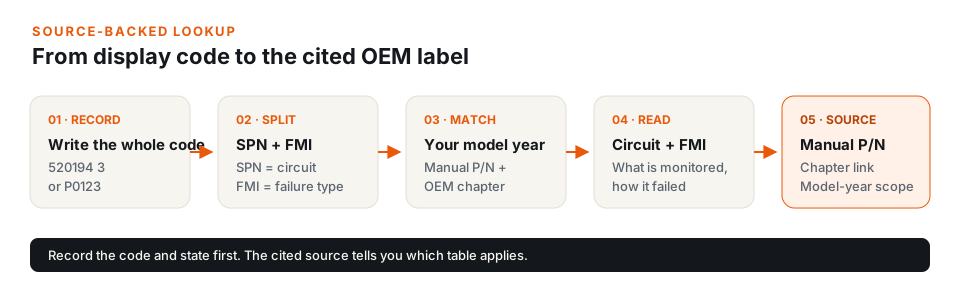
Five steps to a source-backed lookup
- Record the exact code and FMI. A photo of the display is better than memory. Note whether the light is steady or flashing.
- Note the conditions. Cold start, hot engine, full load, turning, or wet conditions all provide context. Intermittent faults often leave the best clue in the freeze-frame data.
- Open the model-year page. Use the code page for your exact machine, not a generic list. Calibrations and code coverage change between trims and years.
- Read the FMI and the label. The FMI describes the failure type; the label names the circuit or condition the OEM chapter associates with it.
- Note the source. Record the manual P/N and chapter. That citation is what connects the entry to your model year and trim.
What the FMI tells you
The FMI is the fastest way to sort a code into a diagnostic category. Voltage-high and voltage-low faults are circuit faults. Open and grounded-current faults are wiring faults. "Data erratic" points to an intermittent connection. An out-of-calibration entry describes a calibration state; the service information for the machine describes the required tool.
| FMI | What it generally means |
|---|---|
| 0 | Data valid, but above the normal operating range (most severe) |
| 1 | Data valid, but below the normal operating range (most severe) |
| 2 | Data erratic, intermittent, or incorrect |
| 3 | Voltage above normal, or shorted to a high source |
| 4 | Voltage below normal, or shorted to a low source |
| 5 | Current below normal, or open circuit |
| 6 | Current above normal, or grounded circuit |
| 7 | Mechanical system not responding or out of adjustment |
| 8 | Abnormal frequency, pulse width, or period |
| 9 | Abnormal update rate |
| 10 | Abnormal rate of change |
| 11 | Root cause not known |
| 12 | Bad intelligent device or component |
| 13 | Out of calibration |
| 16 | Data valid, but above the normal operating range (moderately severe) |
| 19 | Received network data in error |
| 31 | Condition exists (manufacturer-specific) |
What a code does not prove
A code names a monitored circuit or condition. It does not prove that the sensor, pump, or module at the end of the circuit is defective. The same entry can appear with a connector, a harness run, a relay, or a supply-voltage condition. The OEM chapter is the source for the circuit description and any model-specific test information.
Scanner reality check
Powersports ECUs are not standard OBD-II. A generic automotive scanner may power up and read emissions-related data on some machines, but it will not reliably read manufacturer-specific codes, recalibrate a throttle, or command AWD and EPS tests. Use the machine's display, the OEM service tool, or a powersports-specific diagnostic platform.
What this guide does not cover
- Repair procedures for fuel, brake, internal-engine, cooling, or high-voltage systems.
- A determination that a machine is safe to operate with a stored or active code.
- Parts recommendations or a diagnosis for a specific machine.
- Dealer-only calibrations, relearns, or actuator commands.
Those subjects require the OEM service manual and the appropriate tools. This guide covers code formats, table reading, and source tracing only.
What the three labels mean
| Label | What it identifies | Example |
|---|---|---|
| SPN | Suspect parameter number — the circuit, sensor, or function being monitored | SPN 110 is commonly engine temperature |
| FMI | Failure mode identifier — what kind of failure the controller detected | FMI 3 is voltage above normal or shorted high |
| P-code | Powertrain code format used on some displays and manuals | P0123 is a throttle position circuit fault |
| Code | The exact pair or string your display shows | “520194 3” or “P0123” |
The SPN and FMI work together. An SPN without an FMI tells you which circuit is being monitored but not what went wrong. An FMI without an SPN tells you the failure type but not where to look. That is why the pair is the useful unit, and why a lookup form that accepts only one number is usually less precise.
Common SPN families you will see
The same SPN can be used across several Polaris platforms, but the exact circuit and connector can differ. The list below maps common SPN families to the systems named in the tables. It is not a universal diagnostic table; resolve the number against your model-year page.
- SPN 51 — throttle position sensor. The table includes voltage, range, and plausibility entries for the throttle position circuit.
- SPN 110 — engine temperature. The table includes circuit entries and temperature-condition entries for the engine temperature sensor.
- SPN 168 — system voltage. Supply voltage high and low entries. The same voltage condition can appear in more than one controller.
- SPN 523 — gear position. The table includes gear-position circuit entries and related display conditions.
- SPN 636 — crankshaft position. The table includes crank-signal entries associated with no-start and stall conditions.
- SPN 1071 — fan relay driver. The table includes fan relay driver circuit entries.
- SPN 1347 — fuel pump driver. The table includes fuel pump driver circuit entries.
- SPN 520194 — throttle safety signal. The table includes the throttle safety cross-check and its failure modes.
- SPN 520207 — AWD control. The table includes AWD control circuit entries.
- SPN 520221–520231 — EPS / EPAS. The table includes electric steering assist circuit entries.
- SPN 520228 — position encoder. The table includes driveline position encoder entries.
How to read a model-year table
Most of our tables use four columns: the code, the component or system, the failure mode, and the OEM condition or citation. A row such as “SPN 520194 / FMI 7 — throttle safety signal — throttle stuck” is telling you three things at once: which circuit is monitored, what the controller thinks happened, and the OEM label for the condition.
Some manuals publish a condition-only table. The RZR Pro R and Turbo R chapters are the main example: each row is a full condition such as “Absolute Shock Current Error - Compression Front Left,” and there is no separate component and failure column. We render those as a flat Code | Condition table so the OEM text is preserved and no empty fallback column is invented.
A table can also carry a P-code cross-reference. If the manual lists P0123 next to an SPN/FMI pair, both describe the same underlying fault. If it does not, do not force a match from a generic list. The manual is the authority for your model year.
Active, stored, and history
An active code is being seen now. A stored code is a fault that happened earlier and may or may not be present. History can include events that were cleared or logged during a low-voltage event. The same number can appear in more than one state.
The state is part of the record. An active code, a stored code, and a history code with no current symptom are different observations, even when the number is the same. Record the state shown by the display or tool alongside the code.
Record the context, not just the number
The code is only half the evidence. Write down what the machine was doing, how hot it was, whether the light was steady or flashing, and whether the fault reset after a key cycle. If the display has freeze-frame data, photograph it. That context is what lets a technician reproduce an intermittent fault instead of guessing.
- Model year, model, and trim or engine.
- The exact SPN and FMI, or the full P-code, plus the display format.
- Cold, hot, idle, load, turning, wet, or after a bump.
- Any recent battery work, jump start, accessory install, or water crossing.
- Whether the code is active, stored, or history.
- A photo of the display and the manual P/N if you have it.
What a code does not tell you
A code names a circuit or a condition. It does not prove that the sensor, pump, or module at the end of the circuit is defective. The same entry can appear with a connector, a harness run, a relay, or a supply-voltage condition.
A code also does not establish whether a machine is safe to operate. The label is a diagnostic definition, not an operating instruction or a repair determination.
Owner’s manual tables can omit dealer-only codes, running changes, and market-specific variants. If a symptom is real but the table has no matching row, the manual may not be the complete diagnostic source for that build.
When the display shows only a light
Some machines show a check-engine light without text until a service tool is connected. A flashing light may be displayed differently from a steady light, but the pattern is not a substitute for the stored code. The owner’s manual describes the display behavior for each model.
The diagnostic connector is not a generic OBD-II port. The manual or a powersports-specific tool is the source for the connector procedure.
Cross-referencing P-codes and SPN/FMI
If your display shows P0123 and the manual lists an SPN/FMI pair for the same throttle circuit, record both. If the display shows only an SPN/FMI pair and the manual cross-references a P-code, write that down too. The cross-reference is useful when you talk to a dealer or search a table that uses the other format.
Do not assume that a P-code and an SPN with similar digits are the same. P0123 is not SPN 123, and P1646 is not SPN 1646. The formats come from different diagnostic conventions. Use the manual’s cross-reference, not the digits.
Using the decoder correctly
The decoder accepts a pair such as 520194 3, a full string such as SPN 520194 FMI 3, a standalone SPN such as 520194, or a P-code such as P0123. A standalone SPN returns every FMI listed for that circuit, which is useful when you know the circuit but not the failure type. A P-code search returns the models and rows where that code is published.
Pick a model when you know it. The same code can map to different circuits on different platforms, and the model filter keeps the result specific. If the decoder returns no match, the code may belong to a model year that is not published yet. Do not assume a nearby code is the same fault.
Frequently asked questions
What if my display shows a number without an FMI?
It may be an SPN, a P-code, or a proprietary display value. The owner’s manual describes the display format. A standalone SPN can return every FMI published for that circuit, but it is less precise than the full pair.
Why does the same code have a different description on another site?
Generic code lists use standard definitions that may not match Polaris-specific hardware. The OEM chapter for your model year is the source for the table entry.
What does a stored code mean?
A stored code means the fault happened at least once. The conditions recorded when it appeared are part of the evidence. The display or tool may show the same number in more than one state.
Can one voltage event set several codes?
Yes. A supply-voltage event can affect more than one controller, so several entries can appear together. The low-voltage guide explains why the table labels cluster.
What does clearing a code change?
Clearing removes stored data. It does not change the circuit or condition that produced the entry. The OEM manual describes the controller’s clear procedure for each model.
Why does my manual call it a “diagnostic display code” instead of a fault code?
Polaris uses different chapter titles across manuals. The table is still the diagnostic code definitions chapter. Look for the rows with SPN, FMI, or P-code columns.
Where can I find my manual P/N?
The cover or front matter of the owner’s manual, or the Polaris publications portal listing for the model, usually gives the P/N. The P/N confirms which table the page cites.
What if my code is not listed?
A missing row can mean the model year uses a different table, or the code is outside the published owner’s manual chapter. The source list and the model-year hub show the coverage.