Seventy-eight codes that print two names
Search the web for a Polaris code and you get one confident sentence back. The published manuals disagree with the sentence's confidence. Within the tables this site publishes, 105 distinct codes print two or more different labels across model-year records, and 127 SPNs print at least three different title variants. Most of those are wording changes between manual editions. Of those, 6 are something more important: the same printed code means genuinely different things on different tables, because the row behind the code moved to a different component. This guide explains how to tell the two cases apart — and how to verify which one you are looking at before you quote a label.
The distinction is a row-level fact, not a trivia note. A spelling difference can send a citation astray; a meaning shift can send it to the wrong component entirely. The rules in this guide follow directly from the published rows — no interpretation, no third-party lists, just the manuals printed under site links with the OEM manual P/Ns shown.
How the counts are made matters too. Every number on this page comes from the site's published tables — the 16,312 entries across 129 model-year records — and not from any third-party code list, so the label variants described here are variants the OEM manuals actually print, chapter page numbers and P/Ns included. Where the site normalizes cosmetic print variance, the corrections page says so.
Wording-only changes: same pair, different name
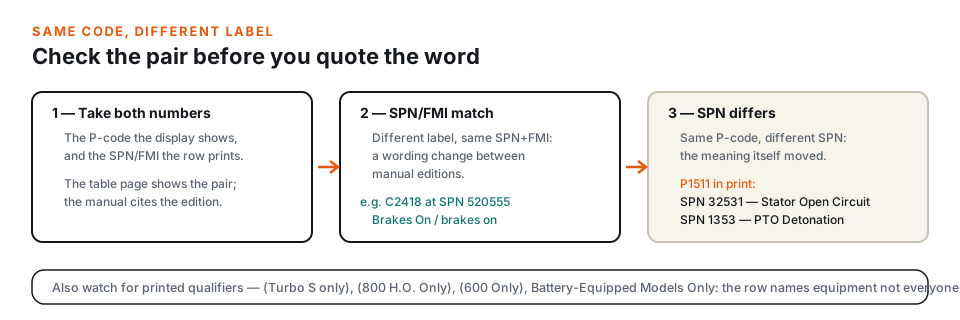
When two rows publish the same P-code at the same SPN and FMI, they are the same row printed in different editions. The labels can differ in obvious ways:
- Family-name changes. SPN 520223 and 520224, the steering torque sensor partial- and full-failure rows, print as Steering Torque Partial Failure and Steering Torque Full Failure — and, at the same FMI 31, as EPS Torque Sensor Partial Failure and EPS Torque Sensor Full Failure on the Kinetic-era tables. Same pair, different choice of family word.
- Prefix swaps. The power-steering receive row (SPN 520226) prints EPAS Communications Receive Data Error on most platforms, EPS Communications Receive Data Error on the Sportsman 570 catalog, and Lost Communication With ECM/PCM “A” on the Pro R family — one row, three published names.
- Pure case differences. The brake-engaged row C2418 prints Riding With Brakes On Moderately Severe on fifteen records and Riding With Brakes on Moderately Severe — lowercase “on” — on one 2022 manual. Nothing changed except the shift key.
- Wording collapse at one edition. The 2027 youth edition prints Canister Purge Valve where the same code-and-pair printed Rollover Sensor (Tipover) through 2026 — the one label change in the youth table, fully documented in the youth guide.
The site normalizes these rows where the manual itself carries printed variants of the same condition, and the corrections page records such editorial normalizations. But a reader citing a label against a machine still wants the printed wording — which is one more reason the manual citation travels with every published table.
The meaning shifts
6 P-codes publish different SPN sets across the tables. They are the cases where “check another table” advice can actively mislead, and each one has a clean story in the print:
- P1511. On the Matryx-era snowmobile manuals, P1511 files to SPN 32531 at FMI 37 — Regulator: Stator Open Circuit. On one 2022 table it appears at SPN 1353, FMI 37 — PTO Detonation. Same code, both FMI 37, different component and a completely different family of service consequence.
- P1610. The same pattern one row over: Regulator: Chassis Voltage Too High at SPN 32523, FMI 31 on the лед Matryx manuals, versus PTO Detonation at SPN 1353, FMI 31 on the same 2022 table.
- P1407 and P1408. In the E-VES exhaust-valve chapter, both codes file to SPN 520335 (Feedback position circuit open / grounded and Abnormal rate of change), while the 88-row main table prints them at SPN 520334 Actuator Diagnostic. The actuator's condition ladder renumbered between chapter editions.
- P2630 and P2632. On the Matryx manuals, the exhaust-valve actuator position rows are specific: SPN 520179 EV Actuator Position Low in Mid Position and SPN 520180 EV Actuator Position Low in Closed Position, both at FMI 18. On the 2022 88-row table, the same two codes collapse onto SPN 520178, printed as EV Position.
All 6 cases therefore span two printed sources. Four of them (P1511, P1610, P2630, P2632) split between the Matryx-era tables and the 88-row 2022 manual; the other two (P1407, P1408) split between that same 88-row manual and the E-VES chapter. None of the differences is a misprint, and each is visible in the printed rows themselves: the SPN column moves with the labels.
One component, eight names: the throttle-first family
The biggest wording spread in the published tables belongs to a component almost every machine carries. SPN 51 — the first throttle-position sensor — prints 8 different labels across the archive: Throttle Position Sensor, Throttle Position Sensor 1, Engine Throttle Valve 1 Position 1, TPS Unrealistic Transition, plus the per-condition variants Throttle Position Sensor 1 Voltage High, … Voltage Low, and the SAE-family Throttle/Pedal Position Sensor/Switch “A” Circuit High and … Circuit Low. Eight names, one component, and the family is not even the record holder: the injector rows at SPN 651 publish 11 label variants once every platform family and chapter prints its own wording.
Two honest readings come out of that spread. First, label-only lookups are a dead end — a bare “throttle position sensor” match cannot say which of the 8 published rows it means. Second, the spread is finite and printed. The 8 names all sit on rows whose pair is public, so a citation that includes the pair and the manual P/N becomes unambiguous even when the label is one variant among many. On this site the printed label travels with the row it belongs to, and variants are normalized only where the manuals themselves repeat a condition; the corrections page tracks those editorial decisions where they affect a published page.
Qualifiers: the printed option rows
Some labels carry their own honesty: a parenthetical or suffix naming the equipment the row belongs to. 16 published labels carry a qualifier: 15 parentheticals - 13 Turbo S, plus the 800 H.O. and 600 wordings - and the Battery-Equipped Models Only suffix. The Turbo S phrases mark the electronic-suspension rows of the 2020 XP Turbo S chapter; the 800 H.O. wording marks the exhaust-actuator driver rows in the display-code table of the 600 AXYS manuals; the battery-equipped suffix marks the charge-relay rows that apply only to machines whose platform carries the second battery.
Spelling note: those labels are part of the published row. A row that does not apply to a machine is not an error in the table; it is the shared diagnostic chapter naming every condition the controller family can report, and the qualifier is the manual telling you which trims and platforms the row belongs to.
The qualifiers also demonstrate why the label deserves a second glance even after the pair matches. The Turbo S phrasing marks 13 distinct labels in the 2020 XP Turbo S chapter, from the inertial-measurement-unit row down to a single steering-offset entry; the 800 H.O. wording marks one driver-family label that prints in 13 rows of one 600 AXYS display-code record. A scanner that reports a match by label alone can silently hand back a row from a heavier trim than the machine in the driveway — precisely the failure the qualifier wording exists to prevent.
Telling the change from the label: the pairing rule
The verification habit is a pairing rule, and it is short enough to remember at the machine:
- Take both numbers from the row, not from memory. Find the code in your model's own table page, and read the SPN and FMI printed beside it.
- Compare the pair, not the label. Same pair, different label — a wording or edition difference; look for the labels printed on your year's row. Different SPN — a meaning shift; the row is not the one the code suggests on other tables.
- Check for qualifiers. If the printed label names an option package, verify the machine has the named feature set before treating the row as applicable.
- Cite the edition. Quote the label, the pair, and the manual P/N together. The decoder keys off the model, so a resolved row comes back with the label your edition prints.
The snow guide went row-by-row
The snowmobile table-structure guide walks four of these cases on the snowmobile side — the exhaust-temperature pair, the relay pair, the same-code rows, and the 83-to-84 transition where a new P-code row appeared on the newer manual.
Frequently asked questions
How many codes actually change label across Polaris manuals?
In the 129 records published on this site, 105 distinct codes print at least two different labels, and 6 of those shift to a different SPN set — a genuine meaning change rather than wording.
Which codes shift meaning?
P1407, P1408, P1511, P1610, P2630, and P2632 — all in the exhaust-valve and regulator/detonation families, all visible in the printed SPN columns.
Why do manuals print different words for the same row?
Manual editions evolve spelling and family naming, and platform families choose different family words (EPS vs steering). The row identity is the SPN/FMI pair; the label describes it.
Why do some labels include “(Turbo S only)”?
The 2020 XP Turbo S chapter qualifies its electronic-suspension rows with the trim that carries the hardware. The qualifier is part of the published label.
Where else does the “same code, different meaning” story appear?
The 2027 youth edition relabeled P0445 from a tipover row to a canister-purge row — same code on the same SPN/FMI pair, but a different part named beside it. The youth guide documents it row by row.
What is the fastest way to check a label against my machine?
Open your model's own table page, find the code, and read the label printed beside it — then compare the SPN/FMI pair. If the pair matches another table's row, treat the label difference as wording; if the SPN differs, the row is not the same fault.
Should I trust label-only lookups on other sites?
Check the pair. A lookup that prints a label without an SPN/FMI and a manual citation cannot show whether the label is the printed one for a specific model year — the failure modes documented on this page are common enough to matter.
Where to look next
- Polaris snowmobile 83-code table — the P1511 and P1610 rows in context, per model-year record.
- 2022 PRO-RMK / RMK KHAOS — the 88-row table whose detonation rows share codes with the regulator rows elsewhere.
- E-VES fault codes — the P140x chapter where P1407 and P1408 file to the feedback-position SPN.
- 2027 youth tables — the P0445 relabel and the reshuffled catalog.
- FMI deep-reading guide — the other half of a row: what the condition number does.
- Why codes change by model year — the year-over-year version of the label story.
This guide is an independent reference prepared from the cited owner’s manuals. It is not affiliated with Polaris Industries, and the owner’s manuals remain the authoritative sources for both the tables and the procedures.