Two machines, same badge, different tables
A 2022 Ranger 1000 and a 2023 Ranger 1000 carry the same model name, but their owner’s manuals do not publish the same diagnostic table. The 2022 manual uses an 83-entry table that is shared with several other Polaris machines. The 2023–2026 manuals use a 78-entry table with different rows. The badge on the fender is similar; the code definitions are not.
This is not an error or a marketing trick. It is how platforms, calibrations, and option packages evolve. A model year can add a sensor, remove a feature, change a controller, or adopt a shared diagnostic chapter from another vehicle line. The table follows the machine, not the name.
This guide explains why model-year tables change, how the index matches a table to a page, and how to find the manual P/N that connects a code to the right chapter. It does not provide repair procedures or a diagnosis for a specific machine.
Why a table changes between model years
There are several reasons a manufacturer may publish a different table for a new model year. A new sensor or actuator can add rows. A feature that was optional can become standard, or a standard feature can be removed. A controller can be replaced with a unit that uses a different code format. A running change within a model year can introduce a new calibration or a different harness.
The table can also change without a visible change to the machine. A manufacturer may consolidate several models onto one diagnostic chapter, or split one model into several chapters based on trim. The rows may be renumbered, relabeled, or reorganized even when the underlying systems are similar. The manual P/N is the reliable way to identify the chapter that applies.
This is why a code lookup should start with the model year and trim, not just the model name. A code that is correct for a 2022 machine may be wrong for a 2023 machine, and a table that covers one trim may not cover another. The index keeps the model year attached to the page and cites the manual P/N for each entry.
One manual can cover several machines
Polaris sometimes publishes one owner’s manual for a group of related machines. The 2026 Sportsman 570 2-Up, Touring, X2, and 6x6 share a manual and a table. The 2026 RZR Pro XP and Pro XP 4 share a manual. The 2022 snowmobile manuals cover the Indy VR1 and the 600 AXYS Indy SP / RMK in separate chapters, but the code families overlap.
A shared manual does not mean the machines are identical. The table can include rows for features that are fitted to one trim and not another. The model notes on the page identify the systems associated with each machine, and the code on the display determines which row applies. The shared table is a definition list, not a claim that every machine has every circuit.
The index publishes the shared table once and lists the model years and manual P/Ns that use it. That keeps the code labels in one place and avoids publishing the same rows under several URLs. The model-year page for each machine links to the shared table and the matching source chapter.
How the index matches a table to a page
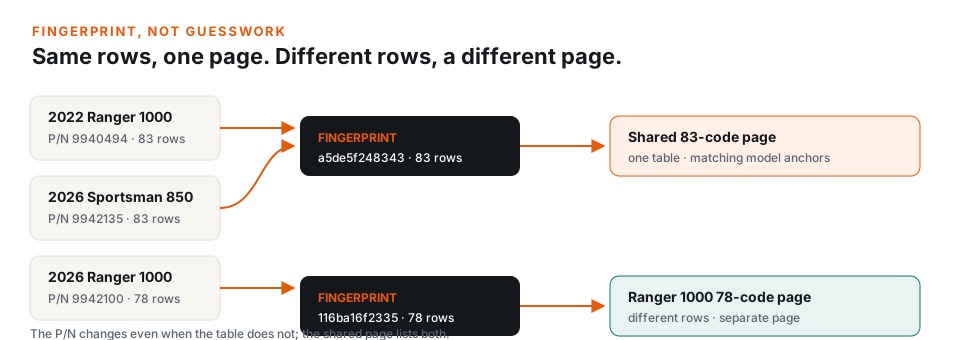
The build normalizes the code rows from each cited chapter and computes a fingerprint. When two manuals publish the same normalized rows, the fingerprint matches, and the table is published once at a canonical URL. The model-year URLs redirect to the matching section of the canonical page. When the rows differ, the fingerprint differs, and the table gets its own page.
The fingerprint is a content check, not a claim that the machines are identical. It answers a narrow question: do these manuals publish the same short code labels in the same order? If they do, one page can serve both citations. If they do not, the pages stay separate even when the model names are similar.
The build also records the manual P/N for each model year. The P/N can differ even when the table is shared. The 2022 Ranger 1000, the 2026 Sportsman 850, and the 2025 Scrambler XP 1000 S use the same 83-entry table, but each manual has its own P/N. The shared page lists the P/Ns so a reader can cite the manual for the machine rather than the page title.
Example: the 83-entry table
The 83-entry table appears in the 2022 Ranger 1000 and Crew 1000, the 2022–2027 Sportsman 850 and XP 1000, the 2025 Scrambler XP 1000 S, and the 2026 Ranger SP 570. The table includes throttle safety, throttle position, engine temperature, crank position, system voltage, AWD, chassis relay, fan relay, gear position, and electric power steering entries.
The machines are not identical. A Ranger 1000 is a utility UTV; a Sportsman 850 is an ATV; a Scrambler XP 1000 S is a sport ATV; a Ranger SP 570 is a smaller utility machine. The table defines codes that may apply to features a particular machine does not have. The shared page notes the systems associated with each machine, and the model-year section lists the manual P/Ns.
The 2022 Ranger 1000 is the only Ranger 1000 year in the 83-entry group. The 2023–2026 Ranger 1000 manuals publish a different table and have a separate page. A reader who uses the 2022 page for a 2023 machine is reading the wrong rows even though the model name is the same.
Example: the 78-entry table
The 78-entry table appears in the 2023–2026 Ranger 1000 and Crew 1000 manuals. It covers engine temperature, idle air control, AWD control, Active Descent control, fan relay driver, fuel pump driver, gear position, and encoder circuits. The rows are related to the 83-entry table but not identical. The fingerprint differs, so the index publishes a separate page.
The 2022 Ranger 1000 manual does not use this table. It uses the 83-entry table that is shared with the Sportsman and Scrambler. The 2022 page and the 2023–2026 page therefore carry different manual P/Ns and different model-year coverage. The separation is intentional; merging them would hide the difference.
A similar pattern appears in the RZR Pro R and Turbo R group. The 2022–2025 Pro R and 2022–2024 Turbo R share a 302-entry condition table. The 2025 Turbo R is not included in that chapter, and the index discloses the gap on the RZR page rather than implying coverage that does not exist.
Finding the manual P/N
The manual P/N is usually printed on the cover or in the front matter of the owner’s manual. It may also appear in the publications portal listing for the model year. The P/N is the most reliable way to confirm that a table belongs to a specific machine.
When the index cites a P/N, it is citing the manual that supplied the rows for that model year. The page date is not a substitute for the P/N. A page can be updated without changing the manual, and a manual can be revised without changing the model year. The P/N is the stable identifier for the source.
If a manual covers several machines, the P/N may be shared across the group. The model-year section on the shared page lists the machines that use the manual so the citation can be matched to the machine. The P/N does not tell you which trim you own; the model year and trim do.
Why old model-year URLs redirect
When a model-year page is consolidated into a shared table, the old URL redirects to the matching section of the canonical page. The redirect preserves the anchor for the model year so a link to the old page still lands near the right citation. The old URL does not stay live with a second copy of the same rows.
The redirect is an editorial decision, not a claim that the machines are identical. It keeps one canonical URL for one table and avoids duplicate content that could confuse a reader or a search engine. The canonical page lists the model years and P/Ns, and the old URL points to that list.
If a redirect lands on a page that does not match your machine, the model-year hub is the place to find the correct page. The hub lists the current coverage and the source for each table.
If your model year is missing
The index is limited to the public OEM chapters that have been cited. A missing model year can mean the chapter is not available, the table has not been indexed, or the model year uses a different table that is not yet published. A nearby year is not a substitute; the rows can differ even when the model name is the same.
The model hub shows the current coverage. If a public OEM chapter for the missing year is available, it can be submitted through the contact address with the model year, model, and manual P/N. The page is added when the chapter can be cited, not when a generic code list is available.
The index does not merge a missing year into an existing page to fill a gap. That would make the coverage look broader than it is and could attach the wrong label to a code. The gap is disclosed instead.
What the model-year page does not claim
The page does not claim that the table is complete for every code a dealer tool can read. Owner’s manual tables can omit service-bulletin codes, running changes, and market-specific variants. The page also does not claim that the machines in a shared group are identical; it claims that the cited manuals publish the same normalized rows.
The page does not provide a repair procedure, a parts recommendation, or a safety determination. It provides the short code labels, the model-year coverage, the manual P/N, and a link to the cited chapter. The OEM manual is the source for model-specific service information.
Questions about model-year coverage
Why does my 2023 model use a different table from the 2022?
Polaris changed the table between the 2022 and 2023 Ranger 1000 manuals. The 2022 manual uses an 83-entry shared table; the 2023–2026 manuals use a 78-entry table. The rows and the P/N differ.
Can I use a code from a nearby model year?
A nearby year is not a substitute. The table can change even when the model name and the visible hardware look similar. Use the page for your model year and trim, and compare the label with the cited chapter.
Why is the same table published on one page for several models?
The manuals publish the same normalized rows. The page keeps one canonical copy and lists the model years and manual P/Ns. The model notes identify the systems associated with each machine.
Does the shared page mean the machines are identical?
No. The table is a shared definition list. A row can describe a circuit or feature that is not fitted to every machine in the group. The code on the display determines which row applies.
How can I confirm the manual for my machine?
The cover or front matter of the owner’s manual, or the publications portal listing for your model year, usually gives the P/N. The P/N is the stable identifier for the source.
Why do some old URLs redirect?
When a model-year page is consolidated into a shared table, the old URL redirects to the matching section of the canonical page. The redirect keeps one canonical URL for one table and preserves the model-year anchor.
Where to look next
- Polaris model and year hub — the current coverage list.
- Shared 83-code table — the 2022 Ranger 1000 and 2022–2027 Sportsman 850 / XP 1000 group.
- Ranger 1000 / Crew 1000 (2023–2026) — the separate 78-entry table.
- RZR Pro R / Turbo R — the 302-entry table and the 2025 Turbo R coverage gap.
- Sources & data — fingerprinting, source selection, and limitations.
This guide is informational. It explains how model-year tables differ and how the index matches a table to a page. It does not provide repair procedures or a diagnosis for a specific machine.