A snowmobile badge does not select a table
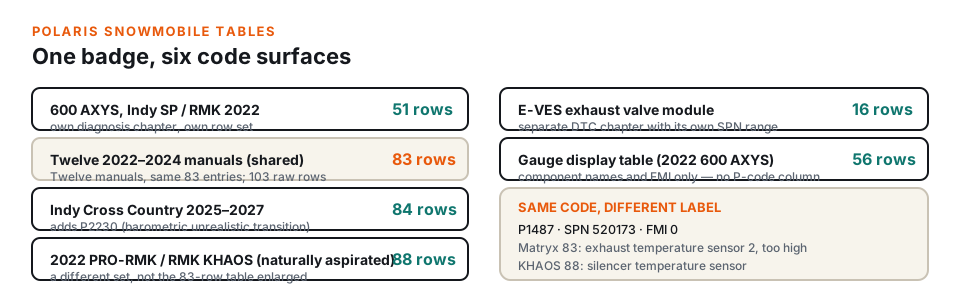
Ask which table “the” Polaris snowmobile uses and the honest answer is: it depends on more than the badge. Between 2022 and 2027, Polaris snowmobile owner’s manuals publish four different main-code tables — a 51-entry table, an 83-entry shared table, an 84-entry successor, and an 88-entry set for one naturally aspirated platform — plus two code lists that live outside the engine diagnosis chapters entirely: a 16-row table for the exhaust valve module and a 56-row gauge display list for one 2022 cluster. Six documents, one brand.
That spread is the reason this site indexes snowmobile tables by model and year rather than by a single brand page. This guide walks through the four main table generations, shows the two chapters that sit outside them, and documents the property that makes snowmobile lookups different from generic OBD-style code lists: the same code number can carry a different label between two of these tables. It describes published rows; it does not provide a repair procedure or a diagnosis for a specific machine.
Four main-code tables, one brand
The four tables are not versions of one list. Their shapes and their inventories differ:
- 51 rows — 2022 600 AXYS Indy SP / RMK (manual P/N 9940120). The oldest table in the current set, built around an earlier platform generation. It carries rows the newer shared table dropped: P0230 (fuel pump driver circuit), P250F (engine oil level sensor), the P1477/P1479 exhaust valve solenoid pair, and a DC chassis voltage pair at P1568/P1569.
- 83 rows — twelve 2022–2024 manuals, shared. Twelve manuals — twelve model-year records — publish the same set: the Indy VR1 / XC / Switchback Assault and 600 Matryx Indy Cross Country years, Matryx ProStar, Indy Boost, Trail Performance, Patriot Boost 9R, and the 2022 PRO-RMK KHAOS Boost. Its inventory is Matryx-era: regulator rows (P1510/P1511), an exhaust-temperature sensor 2 family (P1484–P1488), exhaust-valve actuator position rows (P2627–P2632), and a batch-fire detection row (P3022).
- 84 rows — Indy Cross Country 2025–2027. The 2025 600 Matryx Indy Cross Country added exactly one row, P2230 (barometric sensor, unrealistic transition), and the 84-entry table carried into the 2027 600 Indy Cross Country 136 manual.
- 88 rows — 2022 PRO-RMK / RMK KHAOS (manual P/N 9940124). Not a larger version of the 83. It is a different set with its own wording: gear position sensor rows (P0914/P0916/P0917), knock sensor rows, actuator diagnostics (P1407–P1409), EV learn rows, and a detonation ladder for the PTO cylinder.
The 83-to-84 step is the only one of the four that reads as a normal software revision: one added row, every other row unchanged. The 51 and 88 tables are genuinely different catalogs. Treating “the Polaris snowmobile table” as one thing would attach wrong labels to real machines.
Two more reading notes belong to the four-table era. First, the 51-row table prints qualifier wording directly in its labels — its battery charge relay rows are titled “Battery Charge Relay Battery-Equipped Models Only” — because that table serves both battery-equipped and non-battery trims. Second, label style changed between generations as much as the row inventory did: where the shared 83-row table prints voltage rows as “Battery Voltage Low” and injector rows as “MAG Cylinder Port Injector Open Circuit,” the older table prints “DC Chassis Voltage” and “Fuel Injector (MAG),” and the KHAOS table shortens both to “Battery” and “MAG Injector.” The label is the machine’s; the code is only the address.
Same code, different label
This is the property that deserves the most attention at the workbench. Because two snowmobile tables can print a row under the same code number while describing different conditions, a citation that names only a code can be wrong about the machine. The examples below are printed rows, compared between the site’s published tables:
- P1487 and P1488 (SPN 520173, FMI 0 and 14). On the Matryx-era 83-row table, P1487 is “Exhaust Temperature Sensor 2 – Temperature Too High” and P1488 is “Exhaust Temperature Sensor 2 Mismatch with Sensor 1.” On the 2022 KHAOS 88-row table, the same codes and the same SPN/FMI pairs describe the silencer temperature sensor.
- P140D (SPN 520328, FMI 5). The 600 AXYS 51-row table prints it as “EV Actuator / Gauge Relay”; the KHAOS 88-row table prints the same code and pair as “EV Learn.”
- P1646 and P1647. The 600 AXYS table prints them as “Load Shed Relay,” while the Matryx shared table and the KHAOS table print the same two codes as “Accessory Relay.” One circuit family, two names — the label changed because the platform’s electrical architecture and accessory assignment changed between generations.
- P1511. The 83-row table pairs the code with SPN 32531, FMI 37 — “Regulator: Stator Open Circuit.” The KHAOS table pairs the same code with SPN 1353, FMI 37 — “PTO Detonation.” Even the SPN moved, not just the wording.
A fourth instance crosses chapters rather than tables. The engine tables print P1408 as an actuator diagnostic row; the E-VES module’s own chapter assigns P1408 to “abnormal rate of change” for the module’s valve control, with its own SPN range. The module codes are covered in depth in the E-VES guide.
The discipline that resolves all of these is the same one this site applies everywhere: cite the code with the manual — model year and P/N — and confirm the label against the table for that machine. The decoder resolves codes by model for exactly this reason.
The two chapters outside the engine tables
Two more documents carry codes, and both are easy to miss because they are not “engine DTC” chapters.
The E-VES module table (16 rows). The 2022 600 AXYS manual, and the same model year’s PRO-RMK / RMK KHAOS and KHAOS Boost manuals, publish a diagnostic table for the Electronic Variable Exhaust System in its own chapter. The rows pair P140x codes with an SPN range dedicated to the module (520324–520337) — P1401 for a diagnostic circuit open or grounded, P1409 for actuator overheat, and so on. Because the chapter is separate from the engine diagnosis chapter, a P140x row seen on the display may belong to either document, which is why the E-VES table is published on its own page.
The gauge display table (56 rows). The same 2022 600 AXYS manual also prints a “Diagnostic Display Code Definitions” list for its gauge cluster. Its 56 rows look different on the page: there is no P-code column. Each row is an SPN and FMI pair with a component name — barometric pressure sensor, electronic oil pump, knock level cylinders, chassis relay. Names carry trim qualifiers, such as “EV Actuator Driver (Controller) (800 H.O. Only)” and “Exhaust Valve Solenoid (600 Only),” because the display table serves a cluster family rather than one machine. When a rider photographs a screen that shows an SPN number and a name, this is the list that matches it.
Why twelve manuals print one table
The shared 83-row table is the most reused document in the current set: twelve manuals — twelve model-year records — publish it. Most share one OEM chapter (0000684684); the 2024 Patriot Boost 9R / Slash / Pro RMK Khaos manual uses a different chapter (0000874121) with the same normalized code set. Both chapters carry 103 raw rows, and repeated code rows collapse to the 83 published entries.
Publishing the same 83 rows on twelve URLs would have created twelve near-identical pages, so the site publishes the table once with an anchor for each model-year record, and the old per-year URLs redirect to those anchors. The chapter figure is worth knowing for its practical meaning: a code set this widely shared can name rows for features a specific machine does not have — a boost-only row can sit on a naturally aspirated engine’s table without ever applying to it. The table defines codes; the machine decides which apply.
Record the code, the label, and the manual together
A snowmobile citation is complete when it names the code, the printed label, and the manual behind it (model year and P/N) — because the same number can describe a different condition on the machine next to yours. The published tables keep that attachment mechanical: every row lives on a page that names its manual.
What this guide does not cover
Riders rarely photograph a diagnostic screen with paperwork in hand, so the practical habit is to write down three things at the screen: the code as shown (P-code, SPN, or both), the label if one is displayed beside it, and the model year. Those three facts are enough to move from any of the six documents on this site to the right row, because every published table page names its manual edition and every row carries its SPN/FMI cross-reference where one exists.
This guide explains how the snowmobile tables are organized and how they differ. It does not provide a code-reading procedure for a particular gauge, a code-clearing procedure, a repair procedure, or a diagnosis for a specific machine. The manuals describe when a code displays and direct correction and verification to service information; this guide stops where those directions begin.
Questions about Polaris snowmobile codes
Which 2022 machine uses the 88-row table?
The naturally aspirated 2022 PRO-RMK / RMK KHAOS (manual P/N 9940124). The same model year’s KHAOS Boost record uses the shared 83-row table — the boost engine choice, not the badge, changes the document.
Do all Polaris snowmobiles share one fault-code table?
No. The current set includes four different main-code tables (51, 83, 84, and 88 rows) plus an exhaust valve module chapter and a gauge display list. The model year and manual select the table.
Which table does a 2025 or newer Indy Cross Country use?
The 84-entry table. The 2025 600 Matryx Indy Cross Country added one row (P2230, barometric sensor unrealistic transition) to the 83-row shared set, and the 84-row table continues into the 2027 600 Indy Cross Country 136 manual.
My display shows an SPN number instead of a P-code. Which table matches?
The 2022 600 AXYS gauge display list prints rows as SPN/FMI pairs with component names and no P-code column, and the main tables carry both forms with cross-references. Both identify the same entry; the display table is published on its own page.
Can the same code mean different things on two Polaris snowmobiles?
Yes — that is documented property of these tables. P1487 and P1488 name exhaust-temperature rows on the Matryx-era table and silencer-temperature rows on the 2022 KHAOS table; P140D is “EV Actuator / Gauge Relay” on the 600 AXYS table and “EV Learn” on the KHAOS table. The manual behind the citation decides the label.
Where do P140x exhaust valve codes come from?
The Electronic Variable Exhaust System has its own diagnostic chapter with a 16-row table and a dedicated SPN range (520324–520337). A P140x row can come from that chapter or from an engine table’s actuator rows, so the chapter belongs in the citation.
Why does the shared 83-row table count stay the same while row counts vary elsewhere?
Because 103 raw rows collapse to 83 unique entries after repeated code rows are removed. Raw chapter rows and published entries are two different numbers, and the shared table is simply the document where that revision discipline ran to completion.
Where to look next
- Polaris snowmobile 83-code table (2022–2024) — the shared table with an anchor for each of the twelve model-year records.
- 600 Matryx / Indy Cross Country by year — the 83-to-84 transition and the 2027 Cross Country 136 anchor.
- 2022 600 AXYS Indy SP / RMK — the 51-row platform-era table.
- 2022 PRO-RMK / RMK KHAOS — the 88-row set.
- 2022 E-VES module codes — the 16-row module chapter, and the E-VES guide for how the module state machine reads.
- 2022 600 AXYS display codes — the 56-row gauge display list.
- Code decoder — resolve a code or SPN/FMI pair against the model you cite.
This guide is an independent reference prepared from the cited owner’s manuals. It is not affiliated with Polaris Industries, and the owner’s manuals remain the authoritative sources for both the tables and the procedures.