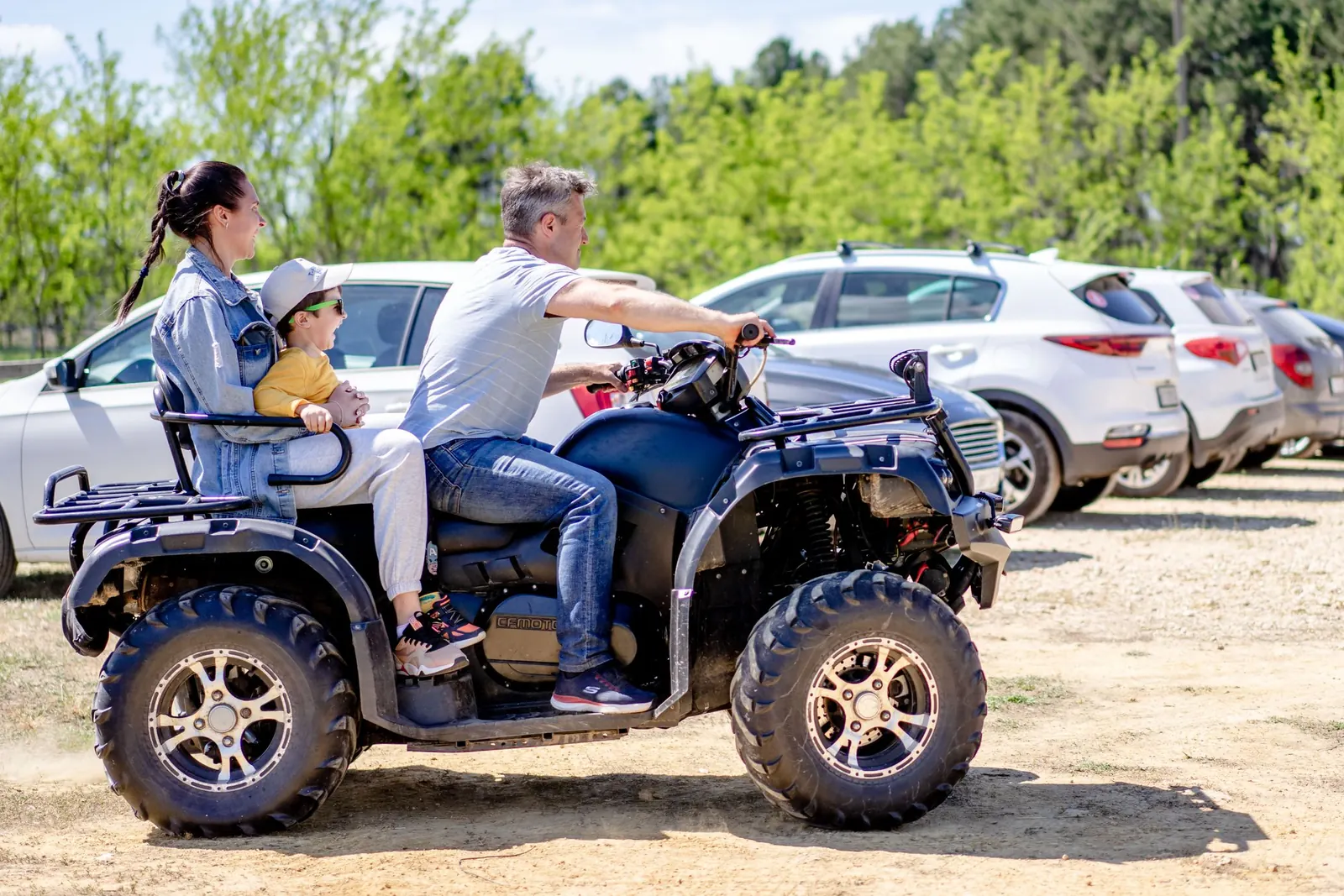
Two youth machines, one shared table
Polaris builds two youth machines — the Ranger 150 EFI side-by-side and the RZR 200 sport UTV — and their owner’s manuals publish one diagnostic table between them. From 2021 through 2026 the two manuals print the same 165-entry table; for 2027 both moved to a 168-entry edition (Ranger 150 manual P/N 9942346, RZR 200 manual P/N 9942347). The 2021 Ranger 150 manual (P/N 9931624) and the 2022 RZR 200 manual (P/N 9931620) opened the run.
A manual table with this many entries for a 150-cc machine surprises people who associate large code lists with big engines, and the table is genuinely different to read from the SPN/FMI-only utility tables on this site. This guide explains what the youth table lists, why several rows name features these machines do not carry, and what actually changed in the 2027 edition — including one code whose printed label moved to a different part. It describes published rows; it does not provide a repair procedure or a diagnosis for a specific machine.
One row, two citations
Every one of the 165 entries pairs a P-code with an SPN/FMI reference. There are no P-code-only rows and no SPN-only rows; the two formats always travel together. That makes the youth table the clearest example on this site of a mechanic from the how-to guide: the same entry can be cited in either form.
The pairing also carries real information. The SPN identifies the monitored parameter in a shared numbering scheme, and the FMI marks the failure condition — a voltage that dropped below range, a signal that went implausible, a circuit left open. Reading a youth row like “Accelerator Position 1” at SPN 91, FMI 3 breaks into three published facts: the component, the parameter ID, and the failure condition. The P-code exists in parallel, and both forms resolve to the same row in a table that never prints them apart.
This structure is why the youth table’s group pages render each row with both columns. If a display, a shop scanner, or a forum reply mentions “P0445” or a bare “520202” for one of these machines, the table page is where the two forms meet.
Several row families print the pattern visibly. The accelerator-position family prints four rows — P0227 and P0228 under “Accelerator Position 1” (SPN 91) and P1227 and P1228 under “Accelerator Position 2” (SPN 29) — plus a sync row that watches the two sensors together (“Accelerator Sensor Sync Fault – Sensor Diff Exceeds Limit,” SPN 520308, FMI 31: the controller’s own agreement check between pedal sensors). The adaptive fuel correction rows print two P-codes on one SPN — P0170 and P1170 both file to “Adaptive Fuel Correction Bank 1” (SPN 520344) at FMIs 15 and 17, and the same pairing repeats for Bank 2 at SPN 520345. The relay rows follow the classic circuit ladder: P0645, P0646, and P0647 take the same component through the voltage-high, voltage-low, and open-circuit conditions.
Rows for equipment the machine does not have
The table’s first rows include a family few buyers notice on a youth UTV: P0645, P0646, and P0647, the air-conditioning compressor clutch relay circuit. The RZR 200 and Ranger 150 do not have air conditioning. The rows exist because the diagnostic chapter is shared across controller variants — the published table defines what the controller can report, not what the buyer’s machine carries.
That is standing disclosure practice on this site: a code names a monitored circuit or condition, and several rows can apply to equipment not fitted to every machine or trim. The practical consequence for a youth-machine owner is worth stating plainly. Seeing nothing displayed beside such a row on a paper table is normal; the row is reference material, not an assignment to find the circuit. The machine decides which rows apply, and only the machine’s own display shows a live code.
What the 2027 edition changed
The 165-to-168 move is not three bolt-on rows. It is a small reshuffle of the row catalog, and it contains the guide’s most instructive example: a code whose label changed while its SPN and FMI stayed identical.
- The tipover rows found their own code ladder. In the 2021–2026 editions, the Rollover Sensor (Tipover) rows were filed under P1504 (SPN 520200, FMI 14) and P0445 (SPN 520202, FMI 4). The 2027 edition re-prints the same SPN 520200 family as its own P-code ladder — P1501, P1502, and P1503 at FMI 2, 3, and 4 — so the tipover condition now has three rows where it previously shared two codes at different parameter sites.
- SPN 520202 became the canister purge ladder. The same SPN at FMI 3, 4, and 5 is now filed under P0443, P0444, and P0445 with the label “Canister Purge Valve.” The FMI 4 row is the direct successor of the old rollover P0445: same code, same SPN/FMI, different label.
- Two genuinely new rows. P0505, “Idle Speed” (SPN 520211, FMI 7), and B1029, “Seat Belt Switch” (SPN 1856, FMI 31). The B1029 row is worth a second look because it joins a seat-belt family that already existed: B1150, B1250, and B1350 all print the same component at the same SPN 1856, and the 2027 edition adds a fourth entry under a new code.
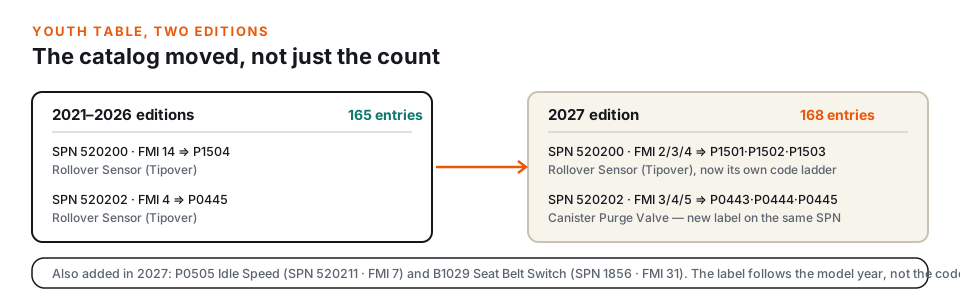
The lesson is the one this site repeats on every page: the label belongs to the manual edition, not to the code alone. A 2026 machine showing P0445 had a tipover row; a 2027 machine showing P0445 has a canister purge row. The model year is part of the citation because the catalog behind the code changed underneath otherwise identical-looking numbers.
Borrowed circuits, shared diagnostics
Beyond the air-conditioning rows, the 165-entry table’s inventory reads like a full-size machine’s controller: accelerator position sensors and their sync fault, adaptive fuel correction for two banks, canister purge behind the 2027 relabel, ignition coils, camshaft and crankshaft signals, oxygen sensors — a component list that maps to emissions and diagnostic requirements rather than to a youth machine’s mechanical trim. The manual publishes the table once; the owner reads only the rows that can apply to the machine’s own controller calibration.
For contrast, the compact end of the sibling family reads differently: the 2026 Ranger 500 publishes a 51-entry table built on SPN/FMI pairs alone, and full-size Ranger 1000 chapters use their own tables. The youth document is one of the few rows-any-both-formats tables on this site, which is why its group pages render every row with the P-code and the SPN/FMI side by side.
Cite the edition with the code
A youth-machine citation is complete when it names the code, the SPN/FMI pair if the display shows one, the label, and the model year. On this age of machine the year changed more of the table than most owners expect — and the decoder and table pages key off the model year for every row.
Recording an entry on a youth machine
The mechanics at the display are the site’s standard practice, applied to this table’s dual format. Write down the P-code if the display shows one; write down the SPN and FMI if the form shown is a parameter pair; write down the label printed beside it, if the cluster shows one. Then identify the manual: the Ranger 150 EFI and RZR 200 manuals are published by model year, and the 2027 P/Ns differ from every earlier year because of the reshuffle described above.
Two habits pay off specifically here. First, quote the year whenever citing P0445, P1504, P1501 — the family of tipover and purge rows — because that is the range where the label moved. Second, when a scanner shows a bare SPN against this table, resolve the FMI before treating the row as identified: the same SPN carries different failure conditions under different FMIs, and the 2027 relabel shows what can happen to a label between editions even when the pair stays put.
What this guide does not cover
This guide explains the youth table’s structure and the 2027 changes. It does not provide a code-reading procedure for the instrument display, a code-clearing procedure, a repair procedure, or a diagnosis for a specific machine. Youth machines carry an additional layer of operating rules — supervision, seating, and safety instructions that belong to the manual’s own chapters — and this guide deliberately stays on the diagnostic row list side of that line.
Questions about the youth table
Are the 2021 and 2026 tables identical?
Yes for content: the 2021 through 2026 manuals publish the same normalized 165-row set, which is why the site publishes them as one shared table page with an anchor per model-year record. The 2027 editions print a different chapter with 168 rows.
Do the Ranger 150 and RZR 200 share a fault-code table?
Yes. The two manuals publish the same normalized table — 165 entries from 2021 through 2026, and a 168-entry edition for 2027. The site publishes the shared table once with an anchor per model-year record.
Why does a 150-cc youth machine have 165 diagnostic rows?
The diagnostic chapter is shared across controller variants, so the published table defines every condition the controller can report. Several rows draw on equipment the youth machines do not carry, such as the air-conditioning compressor clutch relay family.
Did any code change meaning between 2026 and 2027?
Yes. P0445 at SPN 520202, FMI 4 printed as “Rollover Sensor (Tipover)” through 2026 and prints as “Canister Purge Valve” in the 2027 edition — same code, same SPN/FMI pair, different label. The tipover condition moved to its own P1501–P1503 ladder in 2027.
My display shows an SPN number. Which column matches?
Both. Every youth row pairs the P-code with its SPN/FMI, so either form resolves to the same row on the published table page and in the decoder.
What is the B1029 row?
A 2027 add: “Seat Belt Switch” at SPN 1856, FMI 31. It joins a seat-belt family the table already carried — B1150, B1250, and B1350 print the same component at the same SPN — so the component now has four codes instead of three.
Is the 165-row table the same as the full-size Ranger tables?
No. The 2026 Ranger 500, for example, publishes a compact 51-entry SPN/FMI table and full-size Ranger 1000 chapters use their own tables. The youth table’s dual-format rows are its own document family.
Where to look next
- RZR 200 / Ranger 150 fault codes (2021–2026) — the shared 165-row table with anchors for each model-year record.
- 2027 Ranger 150 EFI and RZR 200 — the 168-row 2027 edition and its model sections.
- How to read Polaris fault codes — SPN/FMI and P-code structure, and the FMI glossary.
- Fault codes by symptom — mapping a complaint to code families before a code appears.
- Code decoder — resolve either format against the model you cite.
This guide is an independent reference prepared from the cited owner’s manuals. It is not affiliated with Polaris Industries, and the owner’s manuals remain the authoritative sources for both the tables and the procedures.