The rows that watch the network, not a part
Most fault rows name a component the controller can test with its own wiring: an injector, a relay, a temperature sensor. A second family of rows works differently — it watches the messages modules exchange. That family is larger than most owners expect. Of the 129 model-year records published on this site, 80 carry at least one row from the network families described below, and across those records the most widely published communication entry — a receive-side data error — prints under 3 different labels. This guide introduces the families the printed tables use for network entries — receive-side data errors, transmit-side errors, bus integrity, and pair loss — and what to record when one appears on the display. It describes published rows; it does not provide a repair procedure for the bus itself or a diagnosis for a specific machine.
The most-printed row in the archive
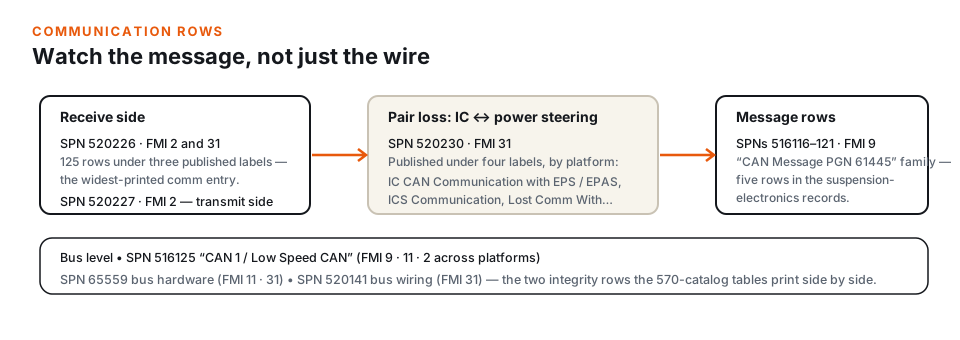
SPN 520226 prints 125 rows across the published records — 97 of them under the dominant EPAS Communications Receive Data Error spelling alone — and the row carries 3 labels in all: EPS Communications Receive Data Error (the Sportsman 570 catalog spelling) and, on the Pro R family tables, Lost Communication With ECM/PCM “A”. Two condition numbers split the same component name: FMI 2 prints on 71 records and FMI 31 adds a second, condition-established row on 54 of those. A receive-data-error row does not name a failed part; it records that a message the module expected did not arrive intact — visible with the word Receive printed on the row.
Once the two spellings and the ECM/PCM wording are understood as one row, the receive family also becomes a useful example of how the published tables agree: the 2022 Ranger 1000 chapter, the 2020 Turbo S chapter, and the 2025–2026 Sportsman records all print it — different machine families, different model years, one message family preserved across them all. The tables differ everywhere else; here they agree.
The transmit side has its own row: SPN 520227, published at FMI 2 in 28 rows under 2 spellings — EPS CAN Communications Transmit Error and an EPAS wording that names the dropped message outright, EPAS CAN Communications Transmit Error No TX Message for x Seconds. The same power-steering family, watched from the other direction of the message.
Bus integrity: hardware, wiring, and speed
Where a table dedicates multiple rows to the network itself, it names the three layers separately. The Sportsman 570 catalog — the shared 2-up, Touring / 6x6, MD, and XP 1000 S records that print the EPS spelling of the power-steering rows — carries:
- SPN 516125, CAN 1/Low Speed CAN Communication Bus — printed at three different condition numbers across platforms: FMI 9 on the consumer 570-family tables, FMI 11 on the Pro XP / Turbo S tables, FMI 2 (Low Speed CAN Communication Bus) on the Pro R family.
- SPN 65559, CAN1 Bus Hardware — printed as a two-row pair at FMI 11 and FMI 31 on those same tables.
- SPN 520141, CAN1 Bus Wiring — FMI 31, printed directly underneath the hardware row.
This is the clearest bus-versus-wiring lesson in the published set: a hardware row names the controller's own bus interface, a wiring row names the physical pair between modules, and the speed row names the bus's operation. Three rows, three layers, all watching fewer wires than most engine-harness families — and the FMI 11 hardware row and the FMI 31 wording print side by side in the same two-row ladder the manuals use for driven circuits.
Pair loss: the instrument cluster and power steering
SPN 520230 parks 4 printed labels on one component — the correspondence between the instrument cluster and the power-steering module. On the consumer 570-family tables it prints IC CAN Communication with EPS at FMI 31; on the newer Touring and XP 1000 S tables, IC CAN Communication with EPAS; on the Pro XP and Turbo S suspension tables, ICS Communication; and on the Pro R family, Lost Communication With Power Steering Control Module “A”.
All four are the same row: the pair between two modules — cluster and steering — has stopped corresponding at FMI 31. The same-code-different-label guide uses this family as its headline wording example, and the row belongs to that guide because those four labels also explain why a label-only citation fails on a network row.
The PGN rows: named messages, one family of records
A few records pass a different lesson: some rows do not name a component at all — they name a message. 5 SPNs print CAN Message PGN rows, all at FMI 9: 516116 (CAN Message PGN 65382), 516117 (65396), 516118 (65314), 516120 (65265), and 516121 (61445). The PGN is a published message identifier — the row refers to a message the bus should be carrying, not a part.
Where those rows live is its own lesson. They appear in exactly 10 records: the RZR XP / Turbo S chapter, the Pro XP family from 2022 through 2026, and the S 1000 / Trail S tables — the machine family whose tables also print the electronic-suspension (ICS) rows. In other words, the PGN rows travel with the machines whose controller set includes the suspension electronics. A 2022 Pro XP record prints 5 of them; a Ranger 1000 record prints none. The tables are complete for their own controller family, and the rows reflect what that family exchanges on the bus.
The same record family also prints one spelled-out message row: SPN 516118, Accelerator Pedal Position and Brake Switch Signal Not Received from Engine Control Module, at FMI 9 on the Pro R tables. That wording is the PGN family in plain language — a specific collaboration between two modules, the pedal signal and the brake-switch signal, and the row says plainly that the message did not arrive. Between the five PGN rows and the spelled-out row, the network family spans from identifier-level messaging to named signals without ever naming a part to replace.
Recording a communication entry
A communication entry still records the site's standard mechanics: the code shown, the SPN and FMI if the display shows the pair, the printed label, the model year, and the manual P/N the table page cites. Two details matter specifically on this family:
- Record the label spelling the table prints. Receive, transmit, hardware, wiring, and pair-loss rows sound alike in a forum post; the wording prints the difference. The row beneath “communication fault” could be SPN 520226, 520227, 516125, 65559, or 520141 — five different published facts.
- Quote the condition number with the SPN. The receive row prints at FMI 2 and FMI 31; the bus hardware row prints FMI 11 and FMI 31; the CAN-row SPN 516125 prints three condition numbers by platform family. A bare SPN cannot identify which printed row a display is showing.
The same family on a different manufacturer's table
Arctic Cat publishes the same idea with its own letter prefixes: U-codes mark network communication loss. The Arctic Cat code guide explains the C/P/U prefixes, and the 2026 Prowler table publishes its U-codes among the 111 rows.
Frequently asked questions
What is the difference between the receive and transmit rows?
They are two published rows on the same power-steering family: SPN 520226 names the receive side and prints 97 rows at FMI 2 and 31; SPN 520227 names the transmit side at FMI 2. The wording — Receive or Transmit — tells you the direction.
Why does one row print under three titles?
Manual editions choose different wordings for the same component. The platform section of the same-code guide shows the three SPN 520226 spellings side by side with the manuals that print them.
What is a PGN?
A published message identifier for a CAN packet — “Parameter Group Number.” The tables use it in five rows (PGN 61445, 65265, 65314, 65382, 65396), all at FMI 9, without naming a component.
Do the PGN rows appear on every machine?
No. In the published records they appear in exactly ten — the RZR Turbo S, Pro XP 2022–2026, and S 1000 / Trail S family. Other records print none, because the rows belong to the suspension-electronics controller family.
Is a communication row a wiring fault?
The rows themselves do not say — that is the point of the separate wiring row. Tables that print both (SPN 520141 wiring, SPN 65559 hardware) name the layers so a display diagnosis can be presented faithfully. This guide stops at reading the labels.
Where are the diesel table's network rows?
The 32-row Ranger Diesel table prints one CAN-timeout row, which the diesel guide explains in the context of that table's longer engine-protection family.
Where does the receive row appear across machine families?
Between its condition numbers it prints on 71 of the 129 published records — Rangers, Sportsmans, RZRs, and the snowmobile line alike — under one of its 3 labels. It is one of the entries the manuals preserve across nearly every platform family.
A communication row does not name a failed part — then what does it record?
The row records that a published message did not arrive or arrived with errors. Sometimes a row names the two modules whose exchange stopped (SPN 520230); sometimes it names a specific signal that did not arrive (the pedal-and-brake-switch row). The tables stop at the published fact.
Why are there so many “EPAS” and “EPS” spellings?
Polaris manuals alternate between the two abbreviations for electric power steering across platform families and years, and two of the network rows have both spellings in print. The label belongs to the manual, not to a component change.
Do EPS rows mean my power steering is broken?
No — several EPS rows are power-save or software rows, and a communication row does not name a failed part. This guide describes the rows; the machine decides which ones apply.
Where to look next
- Sportsman 570 / 600 Tractor, MD & 2-Up — the 288-row work table carrying the hardware/wiring pair and the EPS comm rows.
- Sportsman 570 / 600 Touring, X2 & 6x6 — the EPAS-spelled comm rows and the FMI 19 engine-speed wording from the 2026-era touring tables.
- RZR Pro XP / S 1000 / Trail S — the 202-entry table with the ICS Communication row and the five PGN rows.
- RZR Pro R / Turbo R — the 302-entry tables that spell the receive row Lost Communication With ECM/PCM “A”.
- 2026 Arctic Cat Prowler — U-code comm rows and a separate EPS table with its own C13xx set.
- FMI deep-reading guide — the condition numbers behind these rows, including the communication-loss FMI 19.
This guide is an independent reference prepared from the cited owner’s manuals. It is not affiliated with Polaris Industries, and the owner’s manuals remain the authoritative sources for both the tables and the procedures.