
Arctic Cat prints one combined table with three prefixes
The 2026 Arctic Cat Prowler XT and Prowler XT Crew share one owner’s manual, and that manual publishes one combined diagnostic trouble code table. The table sits in the general information chapter, printed across pages 32 and 33, and it contains 111 entries. Every entry is a display code plus a fault description, and every display code starts with one of three letter prefixes: C, P, or U.
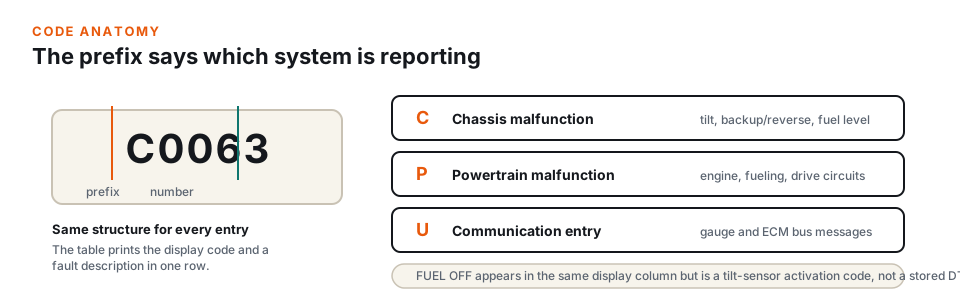
The prefixes are the organizing principle of the whole table. A C prefix marks a chassis-side entry. A P prefix marks a powertrain entry. A U prefix marks a communication entry between modules. Of the 111 rows, 103 are P-codes, five are C-codes, two are U-codes, and one is a display entry that is not a stored diagnostic code at all. This guide explains the prefix structure, the rows in each family, what the display does with a code, and a second, smaller table in a different chapter that owners should know exists.
This guide describes the table the manual publishes. It does not provide a procedure for reading codes from the display, a repair procedure, or a diagnosis for a specific machine.
Reading a C, P, or U entry
An Arctic Cat diagnostic row has two parts: the display code and the fault description. The code’s letter says which system group is reporting; the number selects the row; the description states the fault. Unlike the Polaris SPN/FMI tables, each Arctic Cat code appears exactly once — there is no FMI column, no severity ladder, and no repeated component at different failure levels. The fault description is printed next to the code because the code and its meaning are one row.
For example, C0063 is a tilt sensor circuit reporting high. Its neighbor C0064 is the same circuit reporting low, signal ground, or open. The two-digit family, the tens digit, and the appended letter all stay within one system group, which is why the manual can print the table as one list and still cover three different reporting systems.
What the C rows cover
The five C-codes in the main table describe two chassis systems. The first two rows cover the tilt sensor: C0063 for circuit high and C0064 for low, signal ground, or open. The tilt circuit protects the machine when it is tipped, so the rows print opposite conditions of one circuit.
The remaining three cover the backup and reverse circuits: C1263 for an open circuit, C1264 for circuit high, and C1265 for circuit low or signal ground. Like the tilt pair, they are one circuit measured under different failure conditions, printed as three rows.
Reading the C prefix as “chassis” is accurate for these rows, but the letter does not mean every C-code lives in the main table. The power steering system has its own C-code range, in its own section. That is covered below.
What the P rows cover
The 103 P-codes are the EFI diagnostic table, and their families read like an inventory of a fuel-injected machine’s engine controller. Working through the table region by region:
- Oxygen sensor and fuel trim. P0030 through P0032 (heater circuit), P0130 through P0132 (sensor circuit), and the trim rows P0171 and P0172.
- Airflow and position sensors. P0107 and P0108 (MAP), P0112 through P0118 (intake air and coolant temperature), and P0122 and P0123 (throttle position).
- Injector and coil drivers. P0201 through P0203 (injector control) and P0261 through P0268 (cylinder low/high pairs), plus the ignition-coil driver rows P2300 through P2307.
- Controller supplies and power rows. P0641, P0643, P0651, and P0653 (sensor supplies), P0562 and P0563 (system voltage), and P0685 through P0687 (ECM power control).
- Relay and fan control. P0480 and P0481 (cooling fan speed control) and P0691 through P0694 (fan relay control).
- Throttle and pedal electronics. The P2118/P2119 throttle-body rows, the P2100-series actuator rows, and the pedal-position families P1120 through P1126 and P2122 through P2138, including the correlation rows P2135 and P2138.
- Vapor and fuel-delivery rows. P0444, P0458, and P0459 (evaporative canister control) and P0627 through P0630 (fuel pump control).
- Vehicle speed and controller internals. P0500, P0503, and P0504 (speed), P0325 and P0326 (knock related), P0363 through P0374 (combustion detection), P0600, P0606, P060C, the P061x starter rows, U-communication-adjacent controller rows like P061A and P061F, and P2610 (engine-off timer).
Three observations about this family of rows matter when comparing a display code to the table. First, the same circuit concept can appear in more than one row family — fan control has both a speed-control row pair (P0480/P0481) and a relay-control row set (P0691–P0694) — so the exact number, not the component, selects the row. Second, the P-code numbering follows the SAE convention, so an Arctic Cat P0500 is the same vehicle-speed concept a Polaris P0500 names; the manual’s wiring and circuits differ, which is why the model and year still belong in the citation. Third, several rows describe internal-controller conditions rather than external circuits, and those rows cannot be verified on the harness without service information.
The two U rows
U0100, “Lost Communication with ECM,” and U0155, “LCD Gauge to ECM CAN Communication Lost,” are the table’s communication entries. They sit at the end of the DTC range and describe the gauge’s connection to the engine controller rather than the engine controller’s circuits.
A U-code row is a statement about messaging, not about a component. It can be caused by the same conditions that interrupt any bus: a supply event, a connector, or a wiring run. The row does not say which. That distinction — network evidence versus circuit evidence — is the reason U-codes are worth recording separately from anything that appears near them on the display.
FUEL OFF is a display row, not a stored code
The last row of the table deserves its own paragraph because it terminates the list: FUEL OFF, described as a tilt sensor activation code. It appears in the same display-code column as the C, P, and U entries, but it is a metering state the machine enters when the tilt condition activates, not a stored diagnostic trouble code in the sense of the other 110 rows.
That matters when a machine is returned to service after a tip-over or a jump-start recovery. The display may show FUEL OFF while the controllers hold no stored codes at all. Reading the entry as a fault code would be a category error; it is a state, printed alongside the fault list for convenient reference.
How the display behaves
The manual describes the diagnostic display behavior under its EFI Malfunction Indicator entry. When an EFI error is detected, the LCD information gauge shows a diagnostic trouble code from the table together with a wrench icon, and the code and wrench icon remain displayed until the error is corrected. The same entry carries a note directing the operator between written service steps: the corrections and the system-error reset belong to the service information and a dealer visit.
Two adjacent indicator entries are worth recognizing for what they are not. The coolant temperature indicator illuminates when coolant rises too far above proper operating temperature — it is a temperature alarm with its own section of the manual, not a diagnostic trouble code. The battery voltage indicator illuminates when the battery is low — again a gauge behavior, not a table row. Owners who record codes should note which of these appeared, because an indicator event and a stored code are different kinds of evidence.
EPS uses a separate C-code section
Machines equipped with Electronic Power Steering carry a second, smaller code table in the power steering section of the manual, printed several pages earlier. The EPS section states that the system is self-monitored and will display a malfunction code on the LCD information gauge should an EPS system control circuit problem occur. Its published rows run C1301 through C1329 and cover torque sensor positioning, rotor position encoding, system voltage, temperature thresholds, vehicle-speed and engine-speed checks, internal fault storage, CAN-bus messaging, and gauge state entries such as the “EPS OFF” display and the loss-of-communication row.
Two practical consequences follow. First, a C-code seen on the display may come from this EPS range rather than the main table, so the citation should say which chapter it came from. Second, the EPS table is a different document section from the main DTC chapter, and the two are not cross-referenced. The main diagnostic table page on this site publishes the 111-row chapter, and the section’s own table is published separately on the 2026 Prowler EPS fault codes page.
The printed-typo normalization
One row in the printed table deserves disclosure because this site publishes a corrected reading of it. The printed P0122 row reads “Throttle Position Sensor #1 Circuit ow/SG”, dropping the L of “Low”. The site’s table page publishes the row as “Low/SG” — the standard SAE wording used by the neighboring rows — and notes the change on the page. Corrections of this kind are logged on the corrections page with the reason, and the printed wording is preserved in the research artifacts.
Record the prefix and the chapter together
A row’s citation is complete when it names the code, the manual (year and model), and the chapter — main table or EPS section — because the same letter prefix appears in both. The code selects the row; the chapter proves which table published it.
What this guide does not cover
This guide explains the main table, the display behavior, and the EPS section’s role. It does not list the EPS rows in detail here — they are published on the EPS fault codes page — and it does not provide a code-reading procedure for the instrument cluster, a code-clearing procedure, a repair procedure, or a diagnosis for a specific machine. The manual describes when the display shows a code and directs the correction and reset to the service information; this guide stops where that direction begins.
Questions about Arctic Cat codes
Why do Arctic Cat codes start with C, P, or U?
The manual’s table uses one letter prefix to mark the reporting system: C for chassis, P for powertrain, and U for communication between modules. The number selects the specific row.
Is FUEL OFF a fault code?
No. It is a tilt-sensor activation display entry printed at the end of the table. It describes a machine state, not a stored diagnostic code.
Does the table apply to the XT Crew too?
Yes. The 2026 Prowler XT and the Prowler XT Crew share one owner’s manual, and the diagnostic table is printed once for both variants.
Do the same codes apply to other Arctic Cat model years?
Codes are not guaranteed to transfer across years, and tables can change between editions. Use the table for the manual that covers your exact model year.
What is the wrench icon telling me?
Per the manual’s indicator section, a diagnostic trouble code and the wrench icon display on the LCD information gauge whenever an EFI error is detected, and they remain displayed until the error is corrected.
Where do EPS codes come from?
Power steering machines print a separate C1301–C1329 malfunction table in the power steering section, several pages before the main diagnostic table. That table is published in full on the EPS fault codes page.
Where to look next
- 2026 Prowler XT / XT Crew fault codes — the published 111-row table with the source PDF citation and the P0122 normalization note.
- 2026 Prowler XT / XT Crew EPS fault codes — the published C1301–C1329 power steering table from the same manual.
- Arctic Cat fault codes by model — the brand hub, which explains the three-prefix structure briefly.
- How to read Polaris fault codes — the format comparison also explains how these SAE-style P-codes relate to the SPN/FMI tables used elsewhere on this site.
- Fault codes by symptom — mapping a complaint to code families before a code appears.
- Reading and clearing codes — what active, stored, and history states mean on any machine with a stored record.
- Code decoder — identify format and lookup guidance for a code at the console.
This guide is an independent reference prepared from the cited owner’s manual. It is not affiliated with Textron Specialized Vehicles or Arctic Cat, and the owner’s manual remains the authoritative source for both the table and the procedures.