
Reading a code and clearing a code are different actions
A fault code can be read, recorded, stored, cleared, or allowed to return. Those are separate actions, and they produce different information. Reading a code tells you which row of the OEM table applies. Recording it preserves the state and the conditions. Clearing it removes the stored data from the controller. None of those actions changes the circuit or condition that produced the entry.
This distinction matters because a cleared code is no longer available as evidence. The display may look normal, the light may go out, and the machine may behave differently for a while. The underlying condition can still be present, and the code can return when the same conditions occur. The index can help you identify the label, but it cannot tell you whether clearing is appropriate for a specific machine.
This guide explains where codes appear, what active, stored, and history mean, what clearing changes, and what details are worth recording. It does not provide a clearing procedure or a repair procedure.
Where Polaris codes appear
Depending on the model and trim, a code may appear on the instrument cluster, on a Ride Command display, or only through a service tool. Some machines show a check-engine light without a numeric code until a tool is connected. Some displays show an SPN and FMI as separate numbers; others show a P-code or a message.
The owner’s manual describes the display path for the model. The index does not guess at hidden service menus or publish a connector procedure. The diagnostic connector is not a generic OBD-II port, and the display behavior varies by platform. The manual is the source for the menu path and the display format.
The same code can appear in more than one place. A controller may store a code that the cluster does not display until a service tool requests it. A display may show an active code while a stored code from an earlier event remains in the controller’s memory. The state is part of the entry, not a separate code.
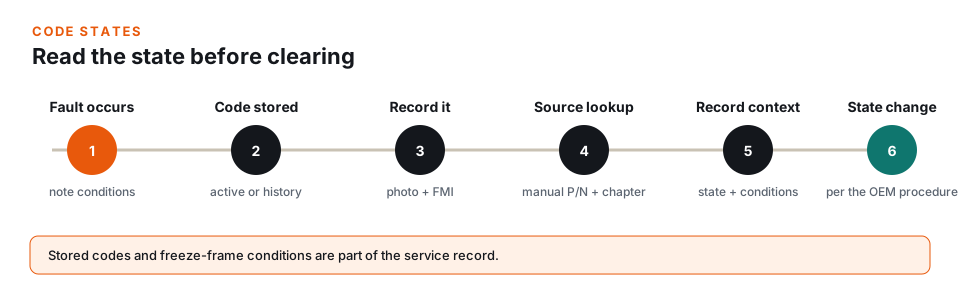
Active, stored, and history
An active code is being reported now. The controller is seeing the condition during the current key cycle or operating period. An active code may illuminate a lamp, show a message, or trigger a reduced-power strategy. The display may update as the condition changes.
A stored code is a fault that happened earlier and may or may not be present now. The controller has saved the entry, but the condition may have stopped. A stored code can become active again if the same conditions return. The stored state is useful because it preserves an event that might not be reproducible on demand.
History can include events that were recorded over a longer period, events that were cleared, or events that the controller logged during a supply-voltage excursion. The exact definition depends on the controller and the model. Some displays use “history” for any stored entry that is not currently active; others distinguish a separate history list.
The same number can appear in more than one state. A code that is active now may also have a stored history from an earlier event. The state changes what the entry means as an observation, even when the number and the label are identical.
What clearing changes
Clearing a code removes the stored data from the controller. Depending on the system, it may also remove freeze-frame data, readiness information, learned values, or a history record. The exact effect depends on the controller and the procedure. The owner’s manual or the service information for the machine is the source for what a clear action does on that model.
Clearing does not change the circuit, the connector, the harness, the sensor, or the condition that produced the entry. It changes the record. If the condition is still present, the controller can set the code again. If the condition is intermittent, the code may stay away until the same conditions return, which can make the interval between clears look like a repair.
Some systems require a relearn or calibration after a clear or after a battery disconnect. The procedure is model-specific. The index does not provide a relearn procedure, a calibration sequence, or a tool recommendation. Those steps belong to the OEM service information.
Why the stored record matters
An intermittent fault is often more visible in the stored record than in the current behavior. The controller may have captured the conditions at the moment the fault set: a temperature, a speed, a load, a voltage, or a sequence of events. That record can be more useful than a code that appears only after a long drive.
The stored record also provides continuity across service visits. A code that was recorded at 200 hours and a code that appears at 250 hours may be the same condition or a different one. The state, the date, and the conditions help distinguish them. A cleared record removes that continuity.
For a used machine, the stored record is part of the history. A scan can show codes that are not displayed on the cluster, and a history entry can show that a condition occurred before the current owner. The index can supply the labels; the scan supplies the entries.
What to record before a clear
If a code is going to be cleared, the record should be complete enough to compare with the OEM table and the service information. The following details are useful:
- The exact code. The full SPN/FMI pair or the P-code, including leading zeros.
- The state. Active, stored, or history, and whether the display showed a steady or flashing lamp.
- The conditions. Cold or hot, idle or load, wet or dry, and any accessory that was running.
- The order of events. Which code appeared first, and whether others followed.
- The model year, model, and trim. The same code can map to a different circuit on another platform.
- The manual P/N and source chapter. The citation connects the entry to the correct table.
A photo is part of the record
A photo of the display captures the code, the state, and the surrounding message in one step. It is more reliable than a handwritten note taken after the screen changes.
Clearing and calibration
Some controllers use a clear action as part of a service procedure. Others require a relearn, a calibration, or a drive cycle after the clear. The requirements vary by system and model. A clear that is performed without the follow-up procedure can leave the controller in a state that does not represent normal operation.
The index does not publish clear sequences, calibration procedures, or drive-cycle instructions. The OEM service information is the source for those steps. The model-year page provides the code label and the chapter citation; it does not provide the procedure.
If a service provider performs a clear, the record should include the procedure used and the follow-up steps. That information is part of the service history, not part of the code label.
Used-machine checks
A used machine can carry codes that the current owner has never seen. A stored code may be from a previous event, a battery replacement, or a service visit. A history entry may be from a condition that was resolved, or from one that is still present. The scan is the source for the entries; the index is the source for the labels.
The absence of a displayed code is not proof that the controller has no stored codes. Some entries are only visible through a service tool. The owner’s manual describes what the display can show, and the service information describes what the tool can read.
A used-machine inspection is a service topic. The index does not provide a purchase checklist or a mechanical inspection procedure. It can help identify the code families that are associated with the systems a buyer may want to have inspected.
What this guide does not cover
This guide does not provide a clear procedure, a repair procedure, a calibration procedure, or a drive-cycle procedure. It does not determine whether a machine is safe to operate or whether a code should be cleared before a service visit. It explains the states and the record so the code can be compared with the cited OEM table.
The cited OEM manual is the source for model-specific service information. The index is a code-label reference, not a service manual.
Questions about code states and clearing
What is the difference between active and stored?
An active code is being reported now. A stored code was recorded earlier and may or may not be present now. The same number can appear in both states.
Does clearing a code fix the machine?
No. Clearing removes stored data. It does not change the circuit or condition that produced the entry. The code can return if the condition is still present.
Why does a code come back after a clear?
The condition that set the code is still present, or the same conditions have returned. The clear changed the record, not the circuit.
Can a low-voltage event create history codes?
Yes. A supply event can cause a controller to reset or log communication and memory entries. Those entries are part of the record, and the conditions help distinguish them from a circuit fault.
Does the index show freeze-frame data?
No. The index publishes short code labels from the cited OEM chapter. Freeze-frame data, live values, and service-tool functions are outside the page.
Where can I find the clear procedure for my model?
The OEM service information for the machine is the source. The owner’s manual may describe the display and the code table; the service manual or dealer tool documentation describes the procedure.
Where to look next
- Fault-code decoder — look up the code and state before a clear.
- Polaris model and year hub — find the table and manual P/N for the machine.
- Sources & data — how source checks, fingerprints, and corrections work.
- Corrections — report a code or citation that does not match the cited chapter.
This guide is informational. It explains code states and the difference between reading and clearing. It does not provide a clearing procedure, a repair procedure, or a diagnosis for a specific machine.