
What “limp mode” describes
“Limp mode” is a name owners use for a family of reduced-power strategies. The machine may cap RPM, limit vehicle speed, soften or ignore throttle input, hold a gear, or refuse to rev past a low threshold. The display may show a check-engine light, a message, or nothing beyond the reduced response. The exact behavior depends on the model, the calibration, and which fault the controller has detected.
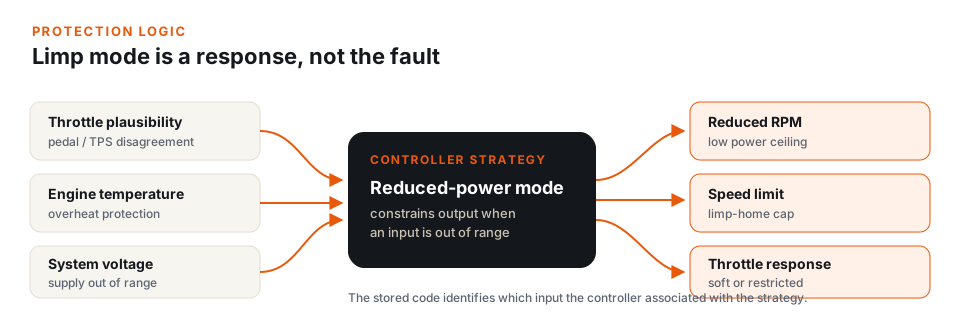
The important point is that limp mode is a response, not the fault itself. The controller is saying that it no longer trusts one or more inputs enough to deliver full output. It is constraining the machine to a mode it can manage with the information it has. The response can feel dramatic even when the underlying fault is small, because the controller is designed to act before the condition becomes worse.
Polaris owner’s manuals describe these strategies in different language. Some call it limp-home mode, some describe a reduced-speed limit, and some simply say the engine will derate when a critical code is active. The label matters less than the stored code and the conditions under which it set. This guide explains the pattern and the table families associated with it. It does not provide a repair procedure or a determination that a machine is safe to operate.
Why a controller reduces output
Modern powersports controllers cross-check several signals at once. Throttle position is compared with the throttle safety signal. Engine temperature is compared with a plausible warm-up curve. Sensor voltage is compared with a reference range. If one signal disagrees with another, the controller has to decide whether the disagreement is real or electrical.
When the disagreement is large enough, the controller can reduce output. A throttle that might be stuck open is more controllable at low power than at full power. An engine that is genuinely hot can be damaged by continued high load. A supply voltage that is moving outside its range can reset a controller at an inconvenient moment. The strategy is a way to keep the machine within a boundary while the controller continues to operate.
That is why a derate can appear with a fault that seems minor. A connector on a throttle circuit can produce the same reduced-power behavior as a failed pedal assembly. The code tells you which circuit the controller mistrusts; it does not tell you that the most expensive part in that circuit is responsible.
The fault families behind many reduced-power events
Across the Polaris tables published on this site, reduced-power complaints often cluster into four families. The list is not exhaustive, and a specific model may use a different strategy, but it is a useful way to organize the table rows you should read.
- Throttle plausibility. The throttle safety signal (often SPN 520194) and throttle position sensor (often SPN 51) must agree. FMI 7, FMI 3, FMI 4, and rate-of-change entries can all be associated with a reduced-power strategy. The label describes the disagreement or the circuit condition, not a failed pedal.
- Engine temperature. SPN 110 with a high-temperature or shutdown FMI can be associated with reduced output. The table may also include a temperature warning entry. The label describes the controller’s observation; it does not provide a cooling-system procedure.
- Supply voltage. System power entries (often SPN 168) and low-voltage behavior can affect several controllers at once. A supply that is outside the expected range can produce a derate without any single sensor being defective. The table may show the supply entry alongside other system entries.
- Sensor plausibility and communication. Crankshaft position, gear position, speed, and encoder signals are used for load and driveline decisions. When one is missing or implausible, the controller may limit output rather than guess. These entries can be intermittent, and the conditions you record are part of the evidence.
Reduced-power mode vs a rev limiter vs a gear limiter
Not every reduced-power behavior is a fault. A rev limiter is a normal engine-protection feature that cuts spark or fuel at a designed RPM. A gear limiter or speed limiter may hold a machine below a calibrated maximum in low range. A cold-engine strategy may restrict RPM until the engine reaches temperature. These are normal behaviors, not codes.
| Behavior | Normal limiter | Fault-driven reduced power |
|---|---|---|
| When it happens | Predictable RPM, gear, or speed threshold | Sudden, repeatable under load, or intermittent |
| Display | No new fault code | Check-engine light, message, or stored code |
| Engine sound | Clean cut at the limit | May run rough, flare, or refuse throttle |
| After key cycle | Same behavior at the same threshold | May reset, then return under the same conditions |
| What the table shows | No table entry | A code or condition that names the input or circuit |
If the behavior arrives with a new noise, a temperature warning, a throttle that does not return, or a burning smell, the machine is describing something beyond a normal limiter. The index can help you identify the code family; it cannot determine the mechanical condition of the machine.
What the display may show
A reduced-power strategy can appear with different display behaviors. Some machines show the SPN and FMI as numbers. Some show a P-code. Some show a message or a wrench icon without a numeric code until a service tool is connected. The owner’s manual describes the display for the model.
The display state is part of the record. A code that is active now is a different observation from a code that is stored from an earlier key cycle. A message that appears only under load is different from a message that appears at every start. The table can supply the label, but the display behavior supplies the context.
Read the code as a record
Record the exact code and FMI, or the exact P-code, before changing the machine’s state. A photo of the display is more reliable than memory. Note whether the light is steady or flashing, whether the machine was cold or hot, and what it was doing when the reduced-power behavior occurred.
Use the decoder or the model-year page for the machine. If the display shows “520194 3,” that is SPN 520194 and FMI 3. If it shows “P0123,” record the P-code and the model year. A code from a different year or a different model may map to a different circuit even when the number looks familiar.
The code and its state are part of the service record. The index does not tell you when to clear a code or how to clear it; it provides the label and the source citation so the record can be compared with the cited chapter.
Model-specific notes
Ranger 1000 and Ranger SP 570. Utility machines often show throttle, AWD, fan, and voltage entries after water crossings or heavy mud. The shared 78-entry table includes rows for systems that may not be fitted to every machine. The code on the display determines which row applies, and the manual P/N connects the entry to the model year.
Sportsman 850 / XP 1000 and Scrambler. The shared 83-code table includes throttle safety, EPS, fan, and chassis relay entries. A supply-voltage event can set several of them at once. The 2022–2027 850 family uses the same table, but the manual P/N and the machine’s options still matter.
RZR Pro R and Turbo R. The 302-entry condition table includes shock, steering, gear, and voltage conditions. A condition such as “Absolute Shock Current Error” does not prove the shock is bad. The condition text is the label; the source chapter is the definition. The page does not include shock, steering-rack, or high-voltage service procedures.
Snowmobiles. Cold batteries, ice in connectors, and throttle safety circuits are part of the winter environment. A machine that behaves normally in a heated shop and reduces power on the trail may have a supply or connector condition that appears only at low temperature. The code and the conditions are the record; the table supplies the label.
What the manual does and does not say
Owner’s manuals publish the diagnostic code tables and, on some models, a description of the reduced-power strategy. They do not usually publish the full service procedure for every circuit. The owner’s manual is the source for the code label, the display behavior, and the model-specific warnings. The service manual is the source for the test procedures and specifications.
The index publishes the short labels from the owner’s manual chapter. It does not publish the long-form repair prose, the dealer-level test plans, or the calibration procedures. That boundary is intentional: the page is a code-label reference, not a service manual.
A code table can also omit dealer-only codes, running changes, and market-specific variants. If the reduced-power behavior is real but the table has no matching row, the owner’s manual may not be the complete diagnostic source for that build. The source list on the model page shows what is covered.
What to record with a reduced-power event
- The exact code and state. SPN/FMI or P-code, active or stored, and whether the light was steady or flashing.
- The conditions. Cold start, hot engine, full load, turning, wet conditions, or a specific speed or gear.
- The display behavior. A numeric code, a message, a wrench icon, or a light without text.
- The model year, model, and trim. The same code can map to a different circuit on another platform.
- The manual P/N and source chapter. The citation connects the entry to the right table.
What this guide does not cover
This guide does not provide a repair procedure, a parts recommendation, or a determination that a machine is safe to operate. It does not describe how to bypass a throttle safety system, how to service a cooling system, or how to work on a high-voltage system. Those subjects require the OEM service information and the appropriate tools.
The index is a code-label reference. The cited OEM chapter is the source for the definition, and the service information for the machine is the source for any procedure.
Questions about reduced-power mode
Is reduced-power mode always an electrical fault?
No. Temperature conditions, throttle plausibility, supply voltage, and mechanical driveline conditions can all be associated with a reduced-power strategy. The code tells you which system the controller flagged; it does not prove the cause.
Why does the code disappear after a restart?
Many faults become stored history when the key cycles. The controller may run normally until the same conditions return. The stored code is still part of the record, and the conditions are often more useful than the code alone.
Does clearing a code restore full power?
Clearing changes the stored data, not the circuit or condition that produced the entry. If the input is still outside its expected range, the strategy can return. The index does not provide a clear procedure.
Why does the same code appear on different models?
Polaris reuses diagnostic tables across model families. The same number can describe a shared circuit or a different circuit depending on the table. The model-year page and the cited chapter resolve the label.
Can the dealer tool show codes that the display does not?
Yes. Owner’s manual tables can omit dealer-only codes and running changes. The source list on the model page shows which chapter is covered; it does not claim to include every code a service tool can read.
Where to look next
- Shared 83-code table — throttle safety, throttle position, temperature, voltage, fan, and EPS entries.
- RZR Pro R / Turbo R — the 302-entry condition table for the 2022–2025 Pro R and 2022–2024 Turbo R.
- Ranger 1000 / Crew 1000 (2023–2026) — the 78-entry table with idle, AWD, fan, and EPAS entries.
- Fault-code decoder — search the reduced-power code by model.
- Sources & data — how the table labels and model years are cited.
This guide is informational. It explains reduced-power strategies and the code families associated with them. It does not provide repair procedures or a diagnosis for a specific machine.