
P-codes and SPN/FMI are two ways of writing a code
A Polaris machine may report a fault as a P-code, as an SPN/FMI pair, or as both depending on the platform and the display. The two formats come from different diagnostic traditions. P-codes are the familiar powertrain codes used across the automotive world. SPN and FMI are the suspect-parameter and failure-mode identifiers used in heavier-duty and off-road controller networks. Polaris manuals use one or both formats, and the same machine can show a P-code on one screen and an SPN/FMI pair on another.
The important point is that neither format is a diagnosis. A P-code is an identifier. It tells you which row of the manufacturer’s table applies, and that row supplies the short label. The label may name a circuit, a signal, a relay, or a condition. It does not tell you that the part named in the label has failed, and it does not tell you what to do next.
This guide explains how the P-code families in the index are organized, why the same number can map to different hardware on different models, and how to keep a lookup attached to the correct model-year table. It does not provide test procedures or repair steps.
How to read a P-code
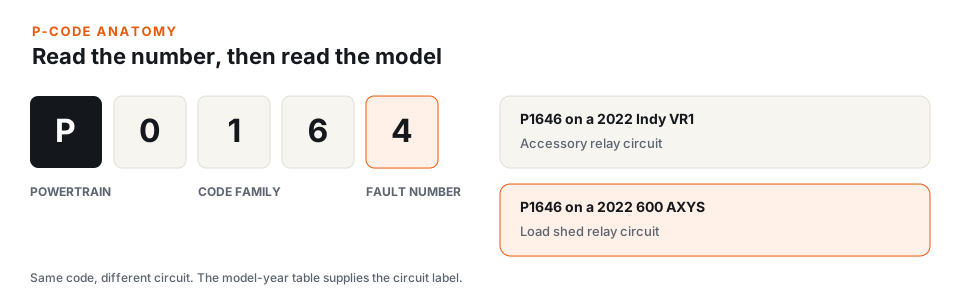
A P-code begins with the letter P, followed by four digits. The letter identifies the powertrain system. The first digit after the letter identifies the code range: a zero is generally a generic code range, a one is generally manufacturer-specific, and other leading digits identify additional ranges. The remaining three digits identify the circuit family and the fault number within that family.
That structure is useful for sorting codes, but it is not a universal dictionary. A manufacturer-specific code such as P1646 can be assigned to different circuits by different manufacturers, and even by the same manufacturer on different platforms. The digits are stable; the meaning is assigned by the table for the machine.
| Part | What it identifies | What it does not identify |
|---|---|---|
P | Powertrain code family. | The specific component on your machine. |
| First digit | Generic or manufacturer-specific range. | A universal part number or test procedure. |
| Middle digits | Circuit family within that range. | Whether the circuit is fitted to your trim. |
| Last digits | Fault number within the family. | A confirmed failed part. |
Why the same P-code can mean a different circuit
The clearest example in the current index is P1646. On a 2022 Indy VR1, the published table labels P1646 as an accessory relay circuit. On a 2022 600 AXYS Indy SP or RMK, the same number is labeled as a load shed relay circuit. The digits did not change. The machine, the manual, and the table did.
This is not a contradiction or an error. Manufacturer-specific code ranges are assigned by the manufacturer, and the assignment can change when the electrical architecture changes. A snowmobile with a different accessory package, a different relay box, or a different controller may use the same number for a different circuit. The same principle applies to P-codes that appear on an ATV or a UTV in a different model year.
That is why a generic code list is not enough for a lookup. A generic list can tell you that P0123 belongs to the throttle position sensor family, but it cannot tell you what the Polaris table for your model year says about the circuit, the connector, or the fitted options. The model-year page is the part of the index that keeps the code attached to the machine.
The P-code families in the index
The current Polaris pages include P-code families from snowmobile manuals and a small number of other platforms. The list below groups the families that appear most often in the published tables. It is a map of the index, not a universal diagnostic table. The exact label for each number is on the model-year page that cites the chapter.
Throttle position: P0120, P0122, P0123
The P0120 family is associated with the throttle position sensor circuit. P0122 is generally the low-voltage side of that circuit, and P0123 is generally the high-voltage side. On a Polaris table, the label may describe the circuit as a whole or name a specific signal condition. The table may also include separate throttle safety entries under an SPN rather than a P-code. The 2022 snowmobile tables, for example, use SPN 520194 for the throttle safety signal and P-codes for other throttle circuits.
A P0122 or P0123 label does not prove that the throttle position sensor has failed. The label names the circuit and the direction of the out-of-range condition. The table may also include plausibility or performance entries that use a different number. The model-year page is the place to compare the number with the label.
Engine temperature: P0117, P0118, P1217
P0117 and P0118 are generally associated with the engine coolant temperature circuit, low and high respectively. P1217 is generally associated with an over-temperature condition rather than a sensor circuit. The distinction matters: a circuit code and a temperature condition can appear in the same table, but they are different kinds of entries.
The Polaris tables also use SPN 110 for engine temperature. The FMI suffix distinguishes a circuit fault from a condition that is above the normal operating range. When a page lists both a P-code and an SPN for the same system, the labels may overlap without being identical. The cited chapter is the authority for the row.
Vehicle speed: P0503
P0503 is generally associated with an intermittent or erratic vehicle speed signal. On a powersports machine, the speed signal can come from a wheel sensor, a transmission sensor, or a controller calculation, depending on the platform. The same P-code can therefore point to a different source on a different model.
The index also publishes SPN 84 for vehicle speed on some tables. The two formats can describe the same system from different angles. The model-year page lists the label that the OEM chapter uses, and the related model notes identify the system that the label belongs to.
Snowmobile throttle release: P1552, P1554, P1555
The P1552, P1554, and P1555 family appears in the snowmobile tables and is associated with the throttle release or throttle safety system. The exact label can describe a circuit high, a circuit low, or a plausibility condition. These entries are part of the throttle safety architecture, which cross-checks the throttle lever and the safety switch.
The index publishes the labels as they appear in the cited chapter. It does not publish a procedure for adjusting, bypassing, or testing the throttle safety system. That system is part of the machine’s safety architecture, and the OEM manual is the source for its service information.
Sensor and relay codes: P2228, P2229, P0545, P0546, P1646, P1647
P2228 and P2229 are generally associated with a barometric pressure circuit, low and high. P0545 and P0546 are generally associated with an exhaust gas temperature circuit, low and high. P1646 and P1647 are manufacturer-specific codes that appear in the snowmobile tables as relay circuits. The generic range gives a hint about the system, but the Polaris table assigns the actual label.
This is especially important for the P16xx range. A generic code list may describe P1646 as an accessory circuit or a relay circuit, but it cannot tell you whether the relay is an accessory relay, a load shed relay, or another function on your machine. The model-year page and the cited chapter resolve that question.
Why several P-codes can appear together
A controller can store more than one P-code from the same event. A shared supply, a shared ground, a communication bus, or a single voltage excursion can affect several circuits at once. The codes may name different components, but the observation may be one event seen from several angles.
The table does not tell you that the codes share a cause. It only lists the labels. The pattern is something you build by recording the codes, the states, and the conditions together. A set of codes that appear at the same time, under the same load, or after the same key cycle is a different observation from the same codes appearing weeks apart.
This is also why a code count is not a parts count. Five codes across five systems do not mean five failed parts. They may mean five controllers recorded the same supply event, or five circuits were affected by one harness run. The index can help you identify the systems; it cannot make the causal connection for you.
How to look up a P-code correctly
- Record the exact code, including leading zeros. P0123 and P123 are not the same lookup. A photo of the display is more reliable than memory.
- Record the model year, model, and trim. The same badge can cover different platforms, and a mid-year change can alter the table.
- Open the model-year page or the decoder. Use the page for your machine, not a generic list. If the decoder returns more than one result, use the model filter.
- Compare the label with the cited chapter. The page gives the short label and a source link. If the label does not match the chapter, the page needs a correction.
- Note the manual P/N and page date. That citation is what connects the entry to your model year and trim. It is also what you would include in a correction request.
What “OEM-listed” means
On this site, “OEM-listed” means the code and short label appear in the cited OEM owner’s manual chapter. It is a source statement. It does not mean the page is an endorsement or a diagnosis, that the part named by the code is defective, or that the table contains every code a dealer tool can read.
What the P-code table does not tell you
A P-code table is a definition list. It does not confirm a failed part, provide a test procedure, or establish whether a machine is safe to operate. It also does not include every code that a dealer-level tool can read. Owner’s manual tables can omit service-bulletin codes, running changes, and market-specific variants.
If a code is not in the published table, the index cannot supply a label for it. A nearby code is not a substitute. The model year may use a different table, or the code may be outside the owner’s manual chapter. The source list on the model page shows what is covered.
For model-specific service information, the cited OEM manual is the source. The index is a way to find the short label and the chapter that defines it, not a replacement for the manual.
Questions about P-codes
Why does P1646 mean different things on two snowmobiles?
P1646 is in a manufacturer-specific range. The number is assigned by the manufacturer, and the assignment can change when the electrical architecture changes. The 2022 Indy VR1 and 600 AXYS tables publish different labels for the same number.
Is a P-code the same as an SPN/FMI pair?
They are different formats. A P-code is a single alphanumeric identifier; an SPN/FMI pair separates the suspect parameter from the failure mode. A table may use one or both, and the mapping between them is model-specific.
Why is my P-code not in the index?
The index is limited to the public OEM chapters that are cited on the model pages. Your model year may use a different table, or the code may be outside the owner’s manual chapter. The model hub shows the current coverage.
Can a P-code be stored without a warning light?
Display behavior is model-specific. Some controllers store a code without illuminating a lamp, and some displays show a message instead of a number. The owner’s manual describes the display for each model.
Does the decoder read my machine?
No. The decoder searches the published index. It does not connect to a controller, read live data, or clear a code.
Where to look next
- Polaris model and year hub — find the published table for a specific machine.
- Fault-code decoder — search the index by SPN/FMI pair or P-code.
- 2022 Indy VR1 / Indy XC / Switchback Assault and 2022 600 AXYS Indy SP / RMK — the two snowmobile tables used in the P1646 example.
- Sources & data — how tables are extracted, fingerprinted, and checked.
- Corrections — report a label or citation that does not match the cited chapter.
This guide is informational. It explains code formats and the structure of the index. It does not provide repair procedures or a diagnosis for a specific machine. The cited OEM manual is the source for model-specific service information.